
The Recommended Reading Path
Dorothy Dunnett’s House of Niccolò is a tightly woven, chronological sequence following the rise and trials of Nicholas vander Poele. Because the plot is highly continuous, with characters aging and political landscapes shifting from book to book, you should read the main series in its original publication order. The chronological timeline of the narrative aligns perfectly with this publication sequence.
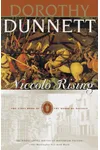
- Niccolò Rising (1986) – Set in 1460, this book introduces Nicholas as Claes, a seemingly lighthearted dyer's apprentice in Bruges who secretly orchestrates brilliant mercantile maneuvers.
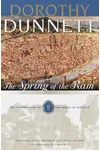
- The Spring of the Ram (1987) – Set in 1461–1462, Nicholas travels to Trebizond, a fragile Byzantine outpost on the Black Sea, to establish trade routes amidst looming Ottoman conquest.
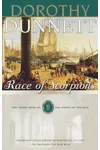
- Race of Scorpions (1989 UK / 1990 US) – Set in 1462–1464, the action moves to Cyprus, where Nicholas becomes embroiled in a civil war for the crown between Queen Charlotte and her half-brother James.
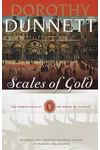
- Scales of Gold (1991) – Set in 1464–1468, Nicholas leads an expedition down the West African coast to the trading hubs of Timbuktu, searching for gold and testing the limits of his ambition.
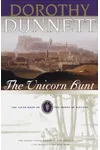
- The Unicorn Hunt (1993) – Set in 1468–1471, the narrative shifts to Scotland, the Sinai Desert, and Flanders as Nicholas deals with deep personal betrayals and hunts for rare dyes and artistic treasures.
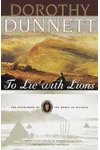
- To Lie with Lions (1995) – Set in 1471–1473, this volume focuses on the high-stakes trade disputes between Flanders, Scotland, and England, alongside Nicholas's complicated marriage and familial conflicts.
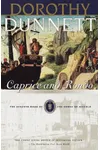
- Caprice and Rondo (1997) – Set in 1473–1477, Nicholas navigates the snowy landscapes of Poland, Russia, and the Baltic, attempting to rebuild his shattered empire after losing almost everything.
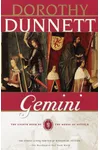
- Gemini (2000) – Set in 1477–1483, the final novel brings the saga to a dramatic conclusion in Scotland, resolving the mysteries of Nicholas's lineage and tying directly into Dunnett's other famous series.
How to Read the House of Niccolò and Lymond Chronicles Together
Dorothy Dunnett wrote two massive, interconnected historical series: the six-volume Lymond Chronicles (set in the mid-16th century) and the eight-volume House of Niccolò (set in the late 15th century). Together, they form a grand 14-volume family saga spanning over a century. However, because the prequel series was written decades after the original series, readers face a classic choice between publication order and chronological order.
The Publication Order (Recommended for First-Time Readers)
Most Dunnett enthusiasts suggest reading The Lymond Chronicles (starting with The Game of Kings) before diving into The House of Niccolò. Because Dunnett wrote Lymond first, she constructed the ancestral reveals and thematic callbacks in Niccolò (especially in the final book, Gemini) to reward readers who already know Lymond's family tree. Reading in publication order also lets you experience the natural evolution of Dunnett’s writing style, which grew increasingly dense, subtle, and complex over her career.
The Chronological Order
If you prefer a linear historical experience, you can start with Niccolò Rising and follow the family lineage forward in time before starting The Game of Kings. While this approach keeps the historical timeline straightforward, some of the ancestral connections and structural echoes designed to surprise Lymond readers will lose their intended impact.
The Fan-Favorite 'Double Loop' Order
For the ultimate Dunnett experience, seasoned readers suggest the 'Double Loop': read The Lymond Chronicles first, then read the entirety of The House of Niccolò, and immediately reread The Lymond Chronicles. Knowing the ancestral history and struggles of Nicholas vander Poele reframes the entire Lymond narrative, turning a reread into a completely fresh, revelation-filled experience.
What to Know Before You Start
Dorothy Dunnett's historical fiction is famous for its high intellectual bar. She does not write simplified period pieces; instead, she drops readers directly into the dense, multi-lingual, and highly complex economic landscape of the Early Renaissance. Here are a few practical tips to help you navigate the series:
- Keep track of the details: The series deals heavily with 15th-century banking, trading guilds, exchange rates, and real-world geopolitics. If you find yourself confused by the financial schemes in Niccolò Rising, don't worry—the plot is designed to keep you guessing, and the emotional and narrative payoffs are immense.
- Watch the dialogue: Dunnett’s characters rarely say exactly what they mean. Subtext, double-bluffs, and political espionage are constant. Paying close attention to the characters' spoken interactions and hidden motivations is key.
- Expect authentic historical figures: Nicholas interacts with real figures of the era, from Anselm Adorne of Bruges to the rulers of Cyprus and Trebizond. Dunnett researched these figures meticulously, ensuring their actions and movements align perfectly with actual historical records.
Essential Companions and Guidebooks
Because Dunnett's novels are packed with obscure Latin, French, and Italian quotes, as well as highly detailed historical references, reader guidebooks are incredibly helpful. The definitive resources are The Dorothy Dunnett Companion (Volume I) and The Dorothy Dunnett Companion II, compiled by Elspeth Morrison. These volumes translate every foreign phrase and provide detailed historical context for the real-life people, trade routes, and events featured in the books. To avoid spoilers, it is highly recommended to consult these guides only after finishing a chapter or during a secondary reading loop.