



Recommended Reading Order: The Original Path
For first-time readers, we highly recommend reading the Bartimaeus books in publication order. The series is structured as a tightly knit trilogy with a standalone prequel that was written later. Starting with the original trilogy ensures you experience Nathaniel's growth, Kitty's rebellion, and the grand finale of Ptolemy's Gate exactly as Jonathan Stroud intended.
- The Amulet of Samarkand (2003) — The story begins here. We meet the ambitious apprentice Nathaniel and the witty 5,000-year-old djinn Bartimaeus, whom Nathaniel summons to steal a powerful amulet.
- The Golem's Eye (2004) — The stakes rise as London faces a mysterious clay golem, and Nathaniel is tasked with bringing down the human resistance led by Kitty Jones.
- Ptolemy's Gate (2005) — The emotional and dramatic climax of the main storyline, wrapping up the character arcs of Nathaniel, Kitty, and Bartimaeus.
- The Ring of Solomon (2010) — A standalone prequel set thousands of years earlier in ancient Jerusalem. It features Bartimaeus serving King Solomon's court and is best enjoyed as a retrospective treat after completing the main story.
The Chronological Path
If you are returning to the series for a reread or prefer to follow the universe's history in order, you can opt for the chronological reading order. This path places the prequel first:
- The Ring of Solomon (2010) — Prequel set in 950 B.C.E.
- The Amulet of Samarkand (2003) — Set in modern-day alternate London.
- The Golem's Eye (2004) — Set two years after the first book.
- Ptolemy's Gate (2005) — Set three years after the second book.
While this chronological path is a fun alternative, starting with the prequel might spoil some of the mystery surrounding Bartimaeus's character and his unique relationship with human sorcerers, which is gradually unpacked in the original trilogy.
The Graphic Novel Adaptation
For fans who want to see the alternate London come to life visually, there is also a graphic novel version of the first book:
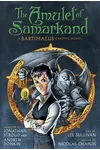
- The Amulet of Samarkand: The Graphic Novel (2010) — Adapted by Jonathan Stroud and Andrew Donkin, with artwork by Lee Sullivan and colors by Nicolas Chapuis. It is a faithful visual adaptation of the first novel's events.
Practical Reading Guidance
No matter which order you choose, there is one golden rule when reading the Bartimaeus Sequence: never skip the footnotes! Bartimaeus's sarcastic, historical, and self-aggrandizing footnotes are a signature element of Jonathan Stroud's writing style, providing much of the series' comedy, worldbuilding, and character development.