





Where to Start Reading the Psychotechnic League
For modern readers looking to dive into Poul Anderson's classic future history, the most logical starting point is the omnibus collection The Complete Psychotechnic League, Volume 1, published by Baen Books. This collection contains the chronological foundation of the series, starting with the short story "Marius," which depicts a war-torn Europe rebuilding in the aftermath of a devastating World War III. Reading the series via the Baen omnibus editions ensures that you get the full scope of the narrative, including all the short stories and standalone novels in their proper chronological sequence.
Alternatively, if you prefer starting with a fast-paced, standalone space opera adventure rather than a collection of shorter pieces, you can pick up the novel Star Ways (also published under the title The Peregrine). While it takes place near the very end of the universe's internal timeline, it functions beautifully as a standalone novel and showcases Anderson's signature style of nomadic interstellar traders and deep-space politics without requiring prior knowledge of the earlier stories.
The Chronological Reading Order
Reading the series chronologically allows you to watch humanity's slow expansion and political evolution. The internal timeline begins in the ashes of World War III and progresses through the rise and fall of the Psychotechnic Institute, eventually leading to deep-space exploration and a far-future twilight. Using the primary book-length releases, the chronological order is as follows:
- The Psycho-technic League (1981) – This Tor collection gathers the earliest stories in the timeline, including "Marius," "The Un-Man," "The Sensitive Man," and "The Big Rain." These stories establish the Psychotechnic Institute and its attempt to guide humanity toward peace.
- Cold Victory (1982) – This second Tor collection covers the mid-era stories, detailing the political struggles, colonization efforts, and the eventual transition away from the League's dominance.
- The Snows of Ganymede (1958) – A short novel focusing on the terraforming of Jupiter's moon Ganymede, taking place during the era of planetary engineering and colonial expansion.
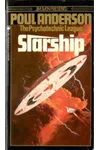
- Starship (1982) – The final Tor collection, gathering late-era stories such as "Gypsy" and "Star Ship" as humanity transitions to deep interstellar travel.
- Virgin Planet (1959) – A standalone novel set on a lost planet inhabited solely by a stranded colony of women who have built their own unique societal structure over generations.
- The Peregrine / Star Ways (1956) – Set near the end of the timeline, this novel focuses on the Nomads, a spacefaring culture of traders living on massive starships traveling between interstellar conflicts.
The Original Publication Order
If you want to experience the series as readers did in the mid-20th century, you can follow the original book publication order. Anderson originally wrote these stories as standalone pieces for science fiction pulp magazines like Astounding Science Fiction, meaning they were not published in chronological sequence. The book-length publication order is:
- The Peregrine / Star Ways (1956)
- The Snows of Ganymede (1958)
- Virgin Planet (1959)
- The Psycho-technic League (1981)
- Cold Victory (1982)
- Starship (1982)
Reading in publication order highlights how Anderson's themes evolved over time, transitioning from the optimistic space operas of the 1950s to the more reflective, politically complex stories compiled in the 1980s.
The Core Collections and Novels Breakdown
To understand the shape of the Psychotechnic League, it helps to distinguish between the standalone novels and the short-fiction collections. The universe spans three standalone novels and three main anthologies:
- The Standalone Novels: Star Ways / The Peregrine, The Snows of Ganymede, and Virgin Planet were originally published as independent science fiction novels in the late 1950s. They focus on specific adventures in the far reaches of space rather than the day-to-day politics of the Psychotechnic Institute.
- The 1980s Tor Anthologies: Edited and arranged by Sandra Miesel, these three paperbacks (The Psycho-technic League, Cold Victory, and Starship) collected Anderson's short stories and novellas from the 1940s and 1950s that had never been published together in book form. Miesel added introductions and essays to thread them into a coherent future history.
- The Baen Omnibus Editions: Published in 2017 and 2018 under the title The Complete Psychotechnic League, these three volumes are the definitive way to read the series today. They integrate the short stories and the standalone novels together into one chronological flow.
What to Know Before You Start: Continuity and Context
Poul Anderson's Psychotechnic League is a fascinating precursor to his more famous Polesotechnic League and Technic History (which features Nicholas van Rijn and Dominic Flandry). However, the two universes are entirely separate. The term "Psychotechnic League" was actually coined by editor Sandra Miesel in the 1980s to create a thematic parallel to the Polesotechnic series, which has occasionally caused confusion among new readers.
At the center of the series is "psychodynamics," a mathematical science of human behavior designed to prevent war and guide societal development. This concept is highly similar to Isaac Asimov's "psychohistory" from the Foundation series. However, while Asimov's psychohistory is treated as a near-infallible guide, Anderson's stories are more skeptical, frequently questioning the ethics of manipulating human societies and exploring the inevitable rise and fall of civilizations. Over time, the series drifted from a speculative future history into an alternate history as real-world geopolitical events diverged from Anderson's timeline, but it remains a landmark of mid-century hard science fiction.