
How to Read the Star Carrier Series
The Star Carrier series by Ian Douglas (the pen name of prolific military sci-fi author William H. Keith, Jr.) is a serialized, linear space opera. Because the plot progresses sequentially, the publication order is identical to the chronological order. Reading the books out of order is highly discouraged, as each novel builds directly on the technical developments, political landscapes, and character evolutions established in the previous installments.
For the best reading experience, start at the beginning with Earth Strike and follow the series in its release order:
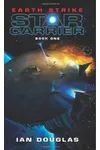
- Earth Strike (2010) – Introduces the conflict between the Earth Confederation and the alien Sh'daar Empire. The star carrier America, led by Admiral Alexander Koenig, is dispatched to fight the Turusch, a hostile vassal race.
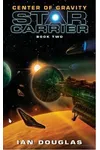
- Center of Gravity (2011) – The battle escalates as the Confederation decides to take the fight to alien systems, putting fighter pilot Trevor Gray and Koenig at the center of a high-risk counteroffensive.
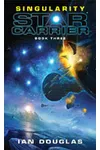
- Singularity (2012) – Humanity edges closer to the technological singularity, a threshold of evolution that the Sh'daar are desperate to halt at any cost.
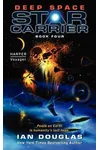
- Deep Space (2013) – Following key victories, the crew of the America ventures into unexplored regions, encountering ancient relics and time anomalies.
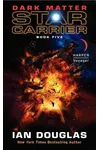
- Dark Matter (2014) – Explores the mystery of dark matter and reveals that the forces shaping galactic politics are older and more complex than previously believed.
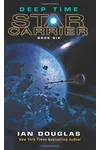
- Deep Time (2015) – The crew must navigate massive cosmic timescales, ancient history, and space-time anomalies that test the limits of human science.
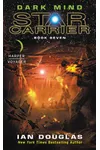
- Dark Mind (2017) – Artificial intelligence and human integration progress rapidly, creating new strategic advantages and severe philosophical challenges.
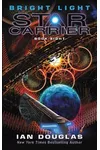
- Bright Light (2018) – The war enters its final stages as the true identity and long-term motivations of the Sh'daar's hidden masters are uncovered.
- Stargods (2020) – The series finale, showing the culmination of humanity's evolution and the ultimate resolution of the war.
What to Know Before You Start
To fully appreciate Star Carrier, it helps to understand a few unique aspects of its setting and tone:
The Battle Over Evolution
Unlike typical space operas centered on territory or resource wars, the central conflict in Star Carrier is ideological. The Sh'daar are a collective of species who believe that technological advancement—specifically artificial intelligence, genetic engineering, and nanotechnology—leads to a dangerous and uncontrollable "Singularity." Because humanity refuses to stop its scientific progress, the Sh'daar seek to force them into a stagnant vassal state or wipe them out entirely.
Hard Science Meets Fleet Action
Author William H. Keith, Jr. brings his background as a former navy corpsman to the series. Space combat is described using realistic physics, including relativistic speeds, time dilation, and kinetic weaponry. The tactics of the space carriers and their fighter squadrons mirror 20th-century naval aviation but scaled up to interstellar distances and light-speed constraints.
"Prims" vs. Augmented Humans
One of the series' primary viewpoint characters, Trevor Gray, begins as a "prim"—a human who has rejected the cognitive and physical implants standard in 25th-century society. This dynamic provides a grounded human perspective as technology advances rapidly around him, forcing him to adapt to a universe where the lines between biology and artificial intelligence are constantly blurring.
Are the Other Ian Douglas Books Connected?
Ian Douglas is famous for his multiple military sci-fi series, particularly the Galactic Marines trilogies (consisting of the Heritage, Legacy, and Inheritance trilogies). While these books share similar themes and technical writing styles, they are set in a completely separate universe. You do not need to read the Galactic Marines books to understand or enjoy the Star Carrier series.