

The Recommended Reading Order
For the best experience, readers should follow the publication order of The Books of the Gods. Because the series introduces a persistent, evolving mythology centering on the mysterious "Faces" (divine masks), reading them in the order they were published allows you to see how the lore grows, how characters connect across books, and how the underlying sci-fi elements are gradually revealed.
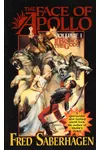
- The Face of Apollo (1998)
- Ariadne's Web (2000)
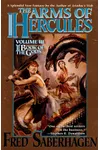
- The Arms of Hercules (2000)
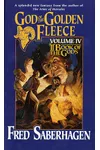
- God of the Golden Fleece (2001)
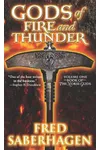
- Gods of Fire and Thunder (2002)
The Books of the Gods: Book-by-Book Breakdown
1. The Face of Apollo (1998)
The series opens with The Face of Apollo, which introduces the core concept of the "Faces"—translucent half-masks that merge mortals with the consciousness and power of ancient deities. The story begins during a clash between the sun god Apollo and Hades, the Lord of the Underworld. When a mortally wounded woman named Sal entrusts a young, downtrodden farm laborer named Jeremy Redthorn with Apollo's mask, his life is transformed. Upon putting it on, Jeremy becomes Apollo’s avatar, gaining immense power (such as controlling swarms of bees) but also drawing the dangerous attention of Hades, who seeks to harvest mortal souls and claim the mask for himself. This book establishes the rules of the universe and sets the tone for the rest of the adventure.
2. Ariadne's Web (2000)
In the second installment, Saberhagen turns his focus to the legend of Theseus and the Minotaur, putting a unique spin on Cretan myth. Ariadne, the daughter of King Minos, is determined to save her lover Theseus from being sacrificed. However, the path is blocked by the unpredictable interference of Dionysus. In this reimagining, the Minotaur is not just a monster, but a tragic figure deformed by his attempt to claim divine powers. The book also expands the universe’s lore by hinting at gods from other cultures, such as Shiva, showing that the influence of the Masks extends far beyond Greece.
3. The Arms of Hercules (2000)
The Arms of Hercules offers a grounded and logical take on the classical hero. Saberhagen portrays Hercules not as a towering, muscle-bound brute, but as a young shepherd of average build who prefers to avoid conflict and let his cousin take the credit for his heroic deeds. As the son of Zeus, Hercules struggles to reconcile his half-divine nature with his mortal desires. While Hercules himself does not need a mask, the plot is driven by divine figures like Daedalus and Hephaestus, who are actively manipulating the magical masks, raising the stakes of the series' overarching conflict.
4. God of the Golden Fleece (2001)
This novel retells the epic quest of Jason and the Argonauts through the eyes of Proteus, an amnesiac who washes ashore after a shipwreck. As Proteus joins the crew of the Argo, he discovers he has supernatural sea-manipulation powers and inhuman strength. He eventually learns that his past self was hired by King Pelias to assassinate Jason, leaving him with a moral dilemma. Along the journey, he encounters Medea and Circe, and must choose between his forgotten orders and his loyalty to his new companions.
5. Gods of Fire and Thunder (2002)
The final book in the series shifts away from Greek myth and transitions into the Norse pantheon. The story follows Haraldur (Hal) the Northman, a secondary character who previously sailed with Jason in God of the Golden Fleece. Seeking a peaceful life as a farmer back in his homeland, Hal is drawn into a new quest when he encounters an impassable wall of magical fire. Legend says a sleeping Valkyrie and a horde of gold lie beyond it. Hal’s quest brings him face-to-face with Norse deities, including Wodan (Odin), Loki, and Thor, culminating the series' exploration of mortal-divine fusion.
The Lore of the "Faces" and Science-Fantasy Underpinnings
One of the most fascinating aspects of Saberhagen’s series is the concept of the "Faces." These are not merely magical items, but indestructible, advanced relics that suggest a highly technological, far-future origin behind what humans perceive as magic. Characters like Hephaestus and Daedalus act as engineers or caretakers of these artifacts rather than typical magical beings. The masks allow a mortal wearer to temporarily fuse with a god, inheriting their ancient memories, personality, and power, but at the risk of losing their own identity. This thematic struggle between human agency and divine destiny runs through every book.
How the Series Connects: Chronological Continuity
While the first four books deal primarily with the Greek pantheon, the transition to Norse mythology in the fifth book is bridged through the character of Haraldur the Northman. Haraldur's presence in both the Argonauts' voyage and the Norse landscape connects the two mythic traditions into a single, cohesive world. The chronological timeline flows directly from the first book through to the fifth, making publication order the ideal reading path. The events of Ariadne's Web and The Arms of Hercules occur in the same mythic era of heroes, while God of the Golden Fleece and Gods of Fire and Thunder form a direct narrative bridge that concludes the saga.
Practical Reader Advice and Standalone Status
Can these books be read as standalones? Yes. Each novel features a self-contained plot with a satisfying resolution to its specific mythological retelling. However, reading them out of order will spoil the broader mystery surrounding the origin of the masks and the true nature of the gods. For the richest experience, start with The Face of Apollo to understand the rules of the Masks, and then read the rest in order. If you prefer to collect physical editions, look for the two omnibus releases: The Books of the Gods, Part One (containing books 1-3) and The Books of the Gods, Part Two (containing books 4-5).