
The Recommended Reading Order: The Linear Path
Unlike many sprawling science fiction franchises that feature complex webs of prequels, spin-offs, and standalone companion pieces, the Gap Cycle (also known as the Gap Sequence) follows a strictly linear narrative. Stephen R. Donaldson constructed this series as a single, continuous epic. Reading the books out of order is not recommended, as each installment builds directly on the events, character transformations, and political developments of the previous one.
Here is the recommended reading path, which matches the original publication order:
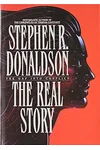
- The Gap into Conflict: The Real Story (1991)
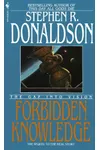
- The Gap into Vision: Forbidden Knowledge (1991)
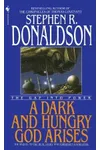
- The Gap into Power: A Dark and Hungry God Arises (1992)
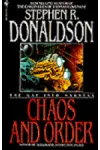
- The Gap into Madness: Chaos and Order (1994)
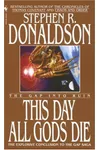
- The Gap into Ruin: This Day All Gods Die (1996)
In 2008, the UK publisher Gollancz released a reprint of the series. At Donaldson's request, this edition combined the first two books, The Real Story and Forbidden Knowledge, into a single physical volume. If you purchase the UK editions, you may find that the series is presented in four physical books rather than five, but the text and reading progression remain identical.
What to Know Before You Start: Tone and Content Warnings
The Gap Cycle is notorious within the science fiction community for its intense, dark, and challenging themes. Before you begin the first book, it is vital to understand that The Gap into Conflict: The Real Story acts as a psychological crucible. It is a tight, claustrophobic, and brutal look at abuse, sexual violence, manipulation, and power struggles. Donaldson intentionally presents characters who are, at least initially, deeply unsympathetic and morally compromised.
Many readers find the first book difficult to get through due to this graphic and distressing content. However, it serves a specific structural purpose. Donaldson designed the first book to establish a baseline of trauma and victim-villain dynamics that he systematically deconstructs, subverts, and redeems over the subsequent four volumes. Once you cross the threshold into the second book, Forbidden Knowledge, the story's scope expands exponentially, transforming from a grim character study into a massive, politically complex space opera featuring galactic conspiracies and alien threats.
The Wagnerian Connection: Space Opera Meets the Ring Cycle
One of the most fascinating aspects of the Gap Cycle is its creative origin. Stephen R. Donaldson initially set out to write a short novella exploring the shifting psychological roles of victim, villain, and rescuer. Finding the initial draft unsatisfying, he looked to Richard Wagner's operatic masterpiece, Der Ring des Nibelungen (the Ring Cycle), for structural and thematic inspiration.
Donaldson adapted Wagner's concepts into a futuristic setting. The struggle for the magical Ring becomes a struggle for economic dominance, political power, and control of the mysterious "gap drive" technology that allows faster-than-light travel. While you do not need to be familiar with Wagner's operas to enjoy or understand the series, readers who know the Ring Cycle will spot compelling parallels between Donaldson's characters and Wagner's figures—such as the pirate Angus Thermopyle mirroring the dwarf Alberich, Morn Hyland reflecting the valkyrie Brünnhilde, and Nick Succorso sharing traits with Siegfried.
Chronological Flow vs. Publication Order
Because the Gap Cycle was written and published in chronological order, there are no timeline adjustments to make. You do not have to worry about jumping backward in time or reading prequel stories. The universe of the Gap Cycle starts small with three main characters aboard a pirate vessel and progressively widens to include space stations, corporate boardrooms, the United Mining Companies Police (UMCP), and the bio-technological threat of the alien Amnion.
This tight, linear structure means there are no alternative reading orders. The publication order is the chronological order, and it is the only way to experience the narrative progression of the characters and the slow reveal of the universe's mechanics.
Spin-offs, Tie-ins, and Co-authored Works
In an era where many successful sci-fi universes are expanded through shared worlds, short story anthologies, and spin-off novels, the Gap Cycle remains uniquely self-contained. Stephen R. Donaldson wrote all five books himself, and he has not published any canonical short stories, sequels, or side stories set in this universe. The story begins on page one of The Real Story and concludes definitively at the end of This Day All Gods Die. You do not need to hunt down obscure magazine publications or companion guides to get the full story.
The Verdict: Can the Books Be Read Standalone?
Absolutely not. While The Real Story was originally conceived as a self-contained piece, its final chapters set up the wider conflict that drives the rest of the series. Attempting to read any of the middle books—such as A Dark and Hungry God Arises or Chaos and Order—without the context of the earlier volumes will leave you entirely lost. The narrative operates as a single novel split into five volumes. For the best experience, commit to the journey from the beginning, keep a steady pace, and prepare for a rewarding, thought-provoking, and deeply emotional conclusion.