


The Recommended Reading Path: Follow the Sequence
Unlike many sprawling science fiction or fantasy franchises, The Long Earth does not require complex navigational charts or chronological debates. The series was meticulously planned as a five-book narrative arc by authors Terry Pratchett and Stephen Baxter. To experience the evolution of the multiverse, the rise of human stepping civilizations, and the overarching philosophical questions the series poses, you must read the books in their official publication order.
Because the story builds chronologically from the initial discovery of stepping to the far-flung future of humanity's expansion, starting anywhere other than the beginning will leave you lost. The plotlines are tightly wound, characters age and change, and the scale of the cosmos expands with every single volume.
The Long Earth Books in Order
Here is the complete sequence of the core novels in the series, showing how the scale of the adventure expands from a simple home-made gadget to the edge of the universe:
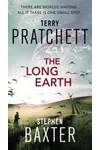
- The Long Earth (2012): The story begins on 'Step Day,' when a blueprint for a simple, potato-powered electronic device is uploaded online. Anyone who builds it can 'step' sideways into an infinite chain of parallel Earths. We are introduced to Joshua Valienté, a natural 'stepper' who doesn't need the device, and Lobsang, a self-aware artificial intelligence who claims to be a reincarnated Tibetan motorcycle mechanic. Together, they embark on a voyage of discovery millions of steps away from the original 'Datum Earth.'
- The Long War (2013): Set a decade after the events of the first book, humanity has established thriving colonies across the parallel worlds. However, political tension rises as the government of Datum Earth attempts to exert tax control and military authority over the new frontiers. Joshua and Lobsang find themselves caught in the middle of a cold war, even as the native, peaceful hominid species (like trolls and elves) face exploitation.
- The Long Mars (2014): The narrative shifts its gaze upward. When it is discovered that the stepping phenomenon isn't limited to Earth, Joshua joins Sally Linsay—the daughter of the stepper device's inventor—on a mission to explore the parallel versions of Mars. Meanwhile, Lobsang stays behind to investigate a massive, earth-shaking mystery closer to home.
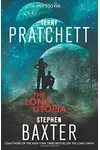
- The Long Utopia (2015): In this fourth installment, Joshua attempts to retire to a quiet life in a remote, peaceful corner of the Long Earth. However, a new threat arises in the form of a strange, mechanical alien species known as the 'silver beetles' that are destroying parallel worlds, forcing him back into action alongside a new generation of explorers.
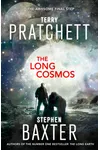
- The Long Cosmos (2016): The final book, published posthumously following Terry Pratchett's passing in 2015, serves as a grand finale. Humanity receives a mysterious, universe-spanning broadcast: a signal inviting them to join the 'Long Cosmos.' The book chronicles the construction of a colossal project to answer the call, bringing the journey of Joshua, Lobsang, and the rest of the cast to a profound conclusion.
The Concept Origin: 'The High Meggas'
If you are a completionist looking for every scrap of lore, you will eventually encounter The High Meggas. This was an unpublished short story written by Terry Pratchett around 1986, right around the time his first Discworld novel was published. He shelved the idea to focus on the massive success of the Discworld, but the core concept—a potato-powered device allowing people to step between parallel Earths—remained in his mind for decades.
While The High Meggas is the seed that eventually grew into The Long Earth, it is not canonical to the novel series. The characters, technology details, and plot lines are different. For example, in the short story, characters step using battery belts rather than the iconic potato-battery boxes. If you want to read it, it is collected in Pratchett's short fiction anthology, A Blink of the Screen, and was also included as bonus material in early special editions of the first novel. It is best enjoyed as a fascinating historical curiosity after you have finished the main novels.
What to Know Before You Start
Before you begin your journey, it helps to understand the unique tone of this series. The Long Earth is a unique hybrid of two very different literary voices. You have the warm, humanist irony, and satirical wit of Terry Pratchett combined with the rigorous, hard-science-fiction realism and cosmic scale of Stephen Baxter. The result is a narrative that is both cozy and mind-bendingly vast.
Unlike high-octane space operas, the series has a deliberate, exploratory pace. Much of the enjoyment comes from the philosophical ideas: What happens to human society, economy, and politics when there is suddenly no land scarcity? What does it mean to be human when we are no longer confined to a single planet? Keep this thoughtful, steady pacing in mind as you start your stepping journey.