

The Recommended Reading Order for Paul Sinclair
The Paul Sinclair series (commonly known as the JAG in Space series) was written by John G. Hemry under his own name, though he is widely recognized today by his space-opera pseudonym, Jack Campbell. Unlike sprawling universes with complex timelines, this series follows a straightforward progression. The chronological order matches the publication order exactly, tracing Paul Sinclair’s career advancement from a green ensign to a seasoned officer.
To get the complete experience, including the hard-to-find standalone novella, read the series in this order:
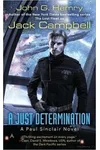
- A Just Determination (2003) - Novel
- Burden of Proof (2004) - Novel
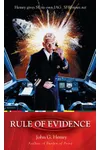
- Rule of Evidence (2005) - Novel
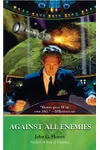
- Against All Enemies (2006) - Novel
- Failure to Obey (2009) - Novella (collected in the anthology Swords and Saddles)
Why the Order Matters: Paul Sinclair’s Career Arc
Reading these books in order is crucial because the narrative functions as a continuous story of career progression and personal growth. We see Paul Sinclair enter the spacefaring Navy as a naive Ensign and watch him learn the complex realities of military law, politics, and command responsibility. Skipping ahead will spoil major character developments, shifts in ship assignments, and the status of Paul's personal relationships—particularly his romance with fellow officer Lieutenant Jen Shen.
1. A Just Determination (2003)
This is the essential starting point for the series. We are introduced to Ensign Paul Sinclair as he reports to his first duty station aboard the warship USS Michaelson. The story takes a dramatic turn when the ship's captain, Pete Wakeman, orders the destruction of an apparently hostile civilian research vessel. Sinclair is thrust into the center of a politically charged legal battle when his captain is court-martialed, forcing the young officer to choose between loyalty to his commander and the absolute truth of the law.
2. Burden of Proof (2004)
Following the intense events of the first book, Sinclair continues his service on the USS Michaelson. When a tragic engine room explosion kills several crew members, the official inquiry quickly points toward a cover-up. The primary suspect is the son of a high-ranking government official, putting immense pressure on Sinclair to sweep the details under the rug. Sinclair must navigate a web of military bureaucracy and political influence to ensure justice is served, even if it threatens his own career prospects.
3. Rule of Evidence (2005)
In the third installment, the stakes become deeply personal for Sinclair. When a catastrophic explosion ruins another Navy vessel, Lieutenant Jen Shen—Sinclair’s girlfriend—is accused of sabotage. Faced with hostile prosecutors and a system eager for a quick scapegoat, Sinclair must step in to defend her. This volume dives deeper into the technicalities of military law and shows a more mature, defensive side of Sinclair as he fights against institutional corruption.
4. Against All Enemies (2006)
The final novel in the core tetralogy shifts the focus toward espionage and security. Sinclair is assigned to a covert Naval Criminal Investigative Service (NCIS) mission to uncover a traitor aboard his ship. With tensions rising between spacefaring factions and the threat of sabotage looming, Sinclair has to balance his duties as an officer with the hidden, deceptive world of counter-intelligence. It provides a satisfying conclusion to his initial tours of duty.
5. Failure to Obey (2009)
Originally published in the July/August 2009 issue of Analog Science Fiction and Fact magazine and later collected in the 2013 anthology Swords and Saddles, this novella serves as a post-series companion. The story takes place after Jen Shen receives a medal for her actions during a terrorist attack, while Chief Petty Officer Ivan Sharpe faces court-martial for his role in the same event. Sinclair works behind the scenes to save Sharpe's career, resolving leftover threads from the main books.
What to Know Before You Start: Tone and Realism
Before diving in, readers should understand that this series is often described as "JAG in Space." If you are looking for explosive space battles, laser dogfights, and alien empires, you might be surprised. Instead, John G. Hemry delivers a realistic, procedurally detailed depiction of military life. Hemry is a retired U.S. Navy officer who drew directly from his own time serving on warships and working with the legal systems of the Navy.
As a result, the books emphasize realistic physics, communication delays across astronomical distances, logistical challenges, and the tedious but essential routines of standing watch and managing paperwork. The primary battlefields in these books are not sectors of space, but rather military courtrooms, where legal arguments, evidence, and ethical questions take center stage.
Connections to Other Works
While the Paul Sinclair series is a self-contained story, fans of Hemry's writing can explore his other military science fiction works. Before writing Paul Sinclair, Hemry wrote the Stark's War trilogy (2000–2002), which focuses on ground-combat military sci-fi. Shortly after finishing Against All Enemies, Hemry adopted the pen name Jack Campbell and launched The Lost Fleet (2006–2010), a massive space-opera series that features the same dedication to realistic fleet maneuvers and military honor, though with much more emphasis on large-scale combat than legal drama.