







Where to Start with Allen Drury
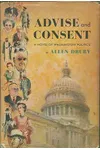
For anyone looking to dive into the world of Allen Drury, the absolute best starting point is his landmark debut novel, Advise and Consent (1959). Winning the Pulitzer Prize for Fiction in 1960, this book is not only Drury's most famous work but also the foundation for his entire Washington political universe. It introduces the high-stakes senate confirmation battles, backroom deals, and recurring characters like the idealistic Senator Brigham Anderson and the cunning Seab Cooley. While some of Drury's series can be read independently, starting with this classic ensures you understand the political stakes, tone, and character dynamics that define his career.
The Advise and Consent Series (Washington Cycle)
This is Allen Drury's signature series, consisting of six novels. However, it is not a straightforward linear progression. After the first four novels, the series splits into two parallel, mutually exclusive timelines following a massive cliffhanger. To read the series properly, follow the publication order for the first four books, and then choose which alternate reality to explore first.
The Linear Core Sequence
- Advise and Consent (1959) – The core Senate confirmation struggle that starts it all.
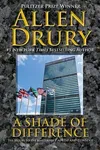
- A Shade of Difference (1962) – Takes the political drama to the United Nations, tackling international relations and racial tensions.
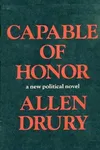
- Capable of Honor (1966) – Focuses on the role of the national media and public opinion during a high-stakes presidential convention.
- Preserve and Protect (1968) – Centers on a violent presidential election campaign, ending with a shocking assassination attempt where the victim's identity is left unrevealed.
The Split sequels: Choose Your Own Path
Because Preserve and Protect ends on an unresolved cliffhanger, Drury wrote two separate novels exploring the two potential outcomes of the assassination. These books are parallel sequels and cannot both exist in the same timeline. You can read them in either order, but reading them in publication order is standard practice:
- Come Nineveh, Come Tyre (1973) – This book explores the timeline where the conservative candidate Orrin Knox is assassinated, leading to the ascension of the demagogic liberal Edward M. Jason to the presidency and a subsequent geopolitical collapse.
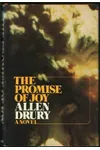
- The Promise of Joy (1975) – This book explores the opposite timeline where Edward M. Jason is assassinated, leading to an Orrin Knox presidency that must navigate a major global war between the Soviet Union and China.
The Mark Coffin Series
Often referred to as Drury's second Washington cycle, this four-book series is set in a separate political universe from the Advise and Consent books. It focuses heavily on the media, young political idealists, and the cold war. It should be read in publication order:
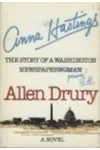
- Anna Hastings (1977) – The story of a ruthless, ambitious woman who rises to become a powerful Washington newspaper publisher.
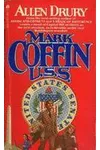
- Mark Coffin U.S.S. (1979) – Follows an idealistic, newly elected young senator from California as he learns the harsh realities of Washington power dynamics.
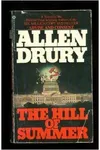
- The Hill of Summer (1981) – A tense Cold War thriller where Mark Coffin and the U.S. President must face off against an aggressive Soviet regime.
- The Roads of Earth (1984) – The direct continuation and conclusion of the international crisis introduced in The Hill of Summer.
The University Series
Drawing heavily from Drury's own formative years at Stanford University, this multi-generational trilogy follows a group of fraternity brothers from their college days in 1938 through the start of the 21st century. It should be read in order:
- Toward What Bright Glory? (1990) – Introduces the fraternity brothers of Alpha Zeta during their senior year at a Stanford-like university, with World War II looming in Europe.
- Into What Far Harbor? (1993) – Picks up after World War II, tracking how the surviving brothers navigate the cultural and political shifts of the post-war era.
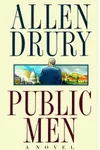
- Public Men (1998) – Published posthumously, this final volume finds the surviving members reuniting in 2001 as one of their own, Senator Richard "Willie" Wilson, contemplates a run for the White House.
The Amarna Series (Ancient Egypt Duology)
In a fascinating departure from modern American politics, Drury wrote a historical fiction duology set in the court of ancient Egypt's 18th Dynasty. However, his focus remained on the machinations of power, drawing direct parallels between ancient religious politics and modern Washington maneuvering. Read these in order:
- A God Against the Gods (1976) – Chronicles the pharaoh Akhenaten's controversial attempt to establish a monotheistic religion centered on the sun god Aten.
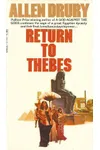
- Return To Thebes (1977) – Picks up after Akhenaten's death, focusing on Tutankhamun's struggle against the established priesthood to restore order.
Standalone Novels & Non-Fiction
Outside of his linked series, Drury published several standalone novels that focus on major American institutions and science fiction, as well as several journalistic non-fiction works:
Standalone Fiction
- That Summer (1965) – A dramatic novel set in an exclusive California resort community.
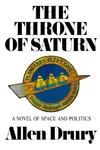
- The Throne of Saturn (1970) – A political science-fiction thriller about a high-stakes, controversial space race to launch the first crewed mission to Mars.
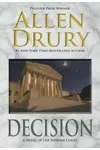
- Decision (1983) – A look at the internal conflicts, legal arguments, and political pressures within the Supreme Court.
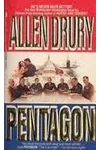
- Pentagon (1986) – A deep dive into the bureaucratic infighting, military politics, and operational struggles inside the Department of Defense.
- The Destiny Makers (1988) – A futuristic political thriller exploring demographic pressures and crisis management in the 21st century.
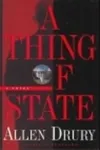
- A Thing of State (1995) – A diplomatic thriller tracking a major international crisis inside the U.S. State Department.
Selected Non-Fiction
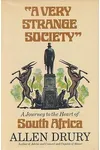
- A Very Strange Society (1967) – A journalistic look at the society of South Africa during the apartheid era.
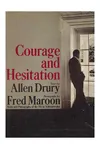
- Courage and Hesitation (1972) – A portrait of the Nixon administration, featuring interviews and photographs.
- Egypt: The Eternal Smile (1980) – A personal travel memoir reflecting Drury's deep fascination with Egyptian history and culture.
What to Know Before You Start
Before diving into Allen Drury's books, it is helpful to keep a few context points in mind. First, Drury's writing is heavily informed by his two decades as a political journalist covering the U.S. Senate. As a result, the descriptions of Senate floor procedures, committee hearings, and press gallery dynamics are incredibly authentic. Second, Drury wrote from a distinct Cold War-era conservative and anti-communist perspective. His books frequently touch on the threats of Soviet expansionism and the dangers of media bias, which reflects the political anxieties of the mid-to-late 20th century. Finally, while his standalones can be enjoyed at any time, his series have strict continuities (except for the split timeline after Preserve and Protect), meaning you will get the best experience by adhering strictly to the recommended orders.