










Where to Start Reading Arthur Koestler
For readers new to Arthur Koestler, the best entry point is his masterpiece, Darkness at Noon (1940). This chilling, psychologically intense novel details the interrogation and trial of an Old Bolshevik under a totalitarian regime, mirroring the Stalinist show trials. It stands as one of the most significant anti-totalitarian novels of the 20th century and functions perfectly as a standalone read.
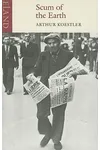
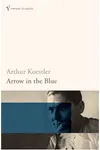
If you prefer to start with his non-fiction, his wartime memoir Scum of the Earth (1941) offers a gripping, first-hand account of his arrest and escape from a French internment camp at the start of World War II. For a broader view of his early life and political awakening, start with the first volume of his official autobiography, Arrow in the Blue (1952).
The "Ends and Means" (Ethical) Trilogy
Although they do not share characters or ongoing storylines, Koestler grouped three of his earliest novels into a thematic cycle often referred to as the Ends and Means Trilogy or the Ethical Trilogy. These books explore the moral dilemma of whether a noble revolutionary end justifies violent or oppressive means:
- The Gladiators (1939): Set in ancient Rome, this novel examines the rise and eventual moral compromise of the Spartacus slave revolt.
- Darkness at Noon (1940): The centerpiece of the trilogy, shifting the thematic focus to the contemporary Soviet-style purges.
- Arrival and Departure (1943): Set during World War II, this novel explores these political and ethical themes on a psychological level through a young refugee fleeing a fascist state.
For the best appreciation of how Koestler's thoughts on revolution evolved, it is recommended to read these three books in their publication order.
The Autobiographical Timeline
Much of Koestler's non-fiction is deeply personal, documenting his transition from a committed Communist Party member to one of its most vocal critics. To read his life story in chronological order, follow this sequence:
- Arrow in the Blue (1952): Covers his birth in 1905, his early years in Budapest and Vienna, and his decision to join the Communist Party in 1931.
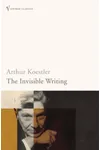
- The Invisible Writing (1954): Details his travels in the Soviet Union, his experiences during the Spanish Civil War, his disillusionment with communism, and his flight to England in 1940.
- Spanish Testament (1937) / Dialogue with Death (1942): These works focus on his imprisonment and sentence of death during the Spanish Civil War. Dialogue with Death was originally published as the second part of Spanish Testament but was later released as a standalone volume focusing entirely on his psychological experiences in solitary confinement.
- Scum of the Earth (1941): Documents his harrowing internment in France and escape to the United Kingdom at the outbreak of the Second World War.
- Stranger on the Square (1984): A posthumous memoir co-authored with his wife Cynthia, capturing their later years together.
The Science and Philosophy Cycle
In the late 1950s and 1960s, Koestler shifted his focus from political struggle to the history of science, creativity, and the human mind. He wrote an unofficial triptych of non-fiction works that should be read in order:
- The Sleepwalkers (1959): A history of Western cosmology focusing on figures like Copernicus, Kepler, and Galileo, arguing that scientific breakthroughs are often reached through intuitive "sleepwalking" rather than linear logic.
- The Act of Creation (1964): An exploration of the shared psychological patterns underlying artistic creativity, scientific discovery, and humor.
- The Ghost in the Machine (1967): A study of the evolutionary shortcomings of the human brain, examining why humanity is uniquely prone to self-destruction and group-think violence.
Arthur Koestler Bibliography: Complete Lists
Publication Order of Standalone Novels
If you want to track his career as a novelist chronologically, follow his fiction in this order:
- The Gladiators (1939)
- Darkness at Noon (1940)
- Arrival and Departure (1943)
- Thieves in the Night (1946) — Set in British-mandate Palestine during the late 1930s.
- The Age of Longing (1951) — A dystopian look at a mid-20th-century Europe fearing an imminent Soviet invasion.
- The Call-Girls (1972) — A satirical novel focusing on academic conferences and intellectual vanity.
Publication Order of Plays
- Twilight Bar (1945) — A satirical four-act play.
Publication Order of Major Non-Fiction Works
- Spanish Testament (1937)
- Scum of the Earth (1941)
- Dialogue with Death (1942)
- The Yogi and the Commissar and Other Essays (1945)
- Promise and Fulfilment: Palestine 1917-1949 (1949)
- The God That Failed (1949) — A collaborative book of essays by ex-communist writers, including Koestler.
- Insight and Outlook (1949)
- Arrow in the Blue (1952)
- The Trail of the Dinosaur (1952)
- The Invisible Writing (1954)
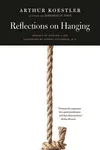
- Reflections on Hanging (1956)
- The Sleepwalkers (1959)
- The Lotus and the Robot (1960)
- The Watershed (1960)
- Hanged by the Neck (1961)
- Suicide of a Nation (1963)
- The Act of Creation (1964)
- The Ghost in the Machine (1967)
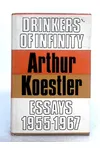
- Drinkers of Infinity: Essays 1955-1967 (1968)
- The Case of the Midwife Toad (1971)
- The Roots of Coincidence (1972)
- Beyond Reductionism (1972)
- The Lion and the Ostrich (1973)
- The Heel of Achilles: Essays 1968-1973 (1974)
- Astride the Two Cultures (1975)
- The Thirteenth Tribe (1976)
- Twentieth Century Views (1977)
- Janus: A Summing Up (1978)
- Kaleidoscope (1981)
- Bricks to Babel (1982)
- Stranger on the Square (1984)
What to Know Before You Start: The Translation Saga
When picking up Darkness at Noon, it is highly recommended to seek out the 2019 translation by Philip Boehm. For nearly eighty years, the English version available to readers was a rushed translation completed in 1940 by Koestler's then-partner, Daphne Hardy, under the threat of the advancing German army. The original German manuscript was presumed lost until a copy was discovered in a Zurich archive in 2015. Boehm's translation restore the precise terminology, dark humor, and philosophical depth of Koestler's original German text.