
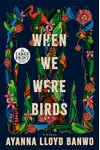
Where to Start: The Recommended Reading Path
For readers looking to dive into the rich, ancestral magical realism of Ayanna Lloyd Banwo, the starting point is clear. Because her bibliography is highly focused, you should begin directly with her award-winning debut novel, When We Were Birds (2022). This novel serves as the cornerstone of her fictional world and introduces readers to her signature blend of Caribbean mythology, patois-infused prose, and themes of legacy and grief.
While Banwo has written several critically acclaimed short stories, they are scattered across various literary journals and anthologies. Starting with her debut novel ensures you experience a fully realized narrative arc before seeking out her shorter, harder-to-find works.
Publication Order of Novels
As a rising star in contemporary speculative fiction, Banwo is expanding her list of publications. Here is the order of her novel-length works by publication date:
- When We Were Birds (2022) — The debut novel set in the fictional Trinidadian city of Port Angeles. It follows Yejide, a woman inheriting the ancestral duty of guiding souls to the afterlife, and Darwin, a devout Rastafarian gravedigger.
- Dark Eye Place (Forthcoming / In Development) — Banwo's highly anticipated second novel. Set in the same shared world, it centers on a family house in a fictionalized Port of Spain passed down through generations of women, exploring themes of legacy, sisterhood, and memory.
Exploring the Short Fiction
If you wish to delve deeper into Banwo's atmospheric writing and thematic foundations, her short stories offer fantastic companion reads. They can be read in any order, though reading them chronologically shows the evolution of her voice leading up to her debut novel:
1. "Nightwalking" (2014)
Published in The Caribbean Writer (Volume 28), this early piece showcases Banwo's interest in the nocturnal life of Trinidad, highlighting the thin boundary between the mundane and the otherworldly.
2. "Dark Eye Place" (2017)
First published in the literary journal Callaloo (Volume 40, Number 2), this story serves as the thematic seed for her forthcoming second novel of the same name. It introduces the concept of an ancestral home that possesses a life and memory of its own.
3. "Public Notice" (2017)
Published in Small Axe (Issue 53), this story won second prize in the 2016 Small Axe Literary Competition. It is highly praised for capturing the distinct cadence, rhythm, and social realities of contemporary Trinidadian life.
4. "Homegoing" (2018)
Appearing in POUi: Cave Hill Journal for Creative Writing (Volume XVIII), this story explores ancestral return and grief. Note: This is a short story and should not be confused with the novel of the same name by Yaa Gyasi.
5. "Nothing the Forest Raises is a Monster" (2018)
Published in the online journal Pree (Issue 1), this story leans heavily into speculative elements, examining the relationship between Caribbean ecology, folklore, and marginalized identities.
6. "Sea Change" (2019)
Published in Anomaly (Issue 28), this short story explores themes of transformation, water, and memory, serving as one of the last major short works published before her debut novel.
What to Know Before You Start
The World of Port Angeles
Banwo's stories are predominantly set in Port Angeles, a fictionalized version of Trinidad's capital, Port of Spain. This setting functions as a character itself, blending bustling urban Caribbean life with mystical undercurrents. Places like the Fidelis Cemetery in When We Were Birds act as literal and figurative borders between the living and the dead.
Language and Rhythm
Banwo writes in a stylized, poetic form of Trinidadian English and patois. Rather than translating or over-explaining local terms for an international audience, she allows the natural cadence of the language to build the atmosphere. Readers are encouraged to let the rhythm of the prose wash over them; the meaning of local terms quickly becomes clear through context.
Folklore vs. Fantasy
Unlike traditional Western fantasy, which relies on rigid magic systems, Banwo's work is grounded in local folklore, spiritual traditions, and ancestral legacy. The supernatural elements—such as the corbeaux (black vultures) that gather around those close to death—are treated as natural parts of the world's fabric rather than anomalies to be solved.