
The Recommended Reading Path: Where to Start
Dr. Chanda Prescod-Weinstein writes books that are as much about the universe as they are about the human hands that study it. Because her books are non-fiction, there is no strict narrative continuity or plot to follow. However, to get the absolute most out of her writing, we recommend reading them in publication order. This sequence allows you to transition naturally from her foundational ideas on cosmology and identity to her more abstract, interdisciplinary explorations of quantum mechanics and pop culture.
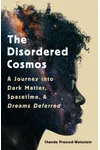
- The Disordered Cosmos: A Journey into Dark Matter, Spacetime, and Dreams Deferred (2021) – Start here to build your foundation. This book introduces Prescod-Weinstein’s personal journey as a theoretical physicist, her love for dark matter, and her perspective on why science must be equitable.
- The Edge of Space-Time: Particles, Poetry, and the Cosmic Dream Boogie (2026) – Read this second. It expands on the concepts introduced in her debut, diving deeper into the quantum nature of space-time, black holes, and the frontiers of quantum gravity, while weaving in music, literature, and art.
Chanda Prescod-Weinstein Books in Publication Order
Here is the complete list of Dr. Prescod-Weinstein's general-audience books, organized by their original release dates:
- The Disordered Cosmos: A Journey into Dark Matter, Spacetime, and Dreams Deferred (Published March 9, 2021 by Bold Type Books)
- The Edge of Space-Time: Particles, Poetry, and the Cosmic Dream Boogie (Published April 7, 2026 by Pantheon Books)
An In-Depth Look at the Books
1. The Disordered Cosmos (2021)
Her debut book is a groundbreaking blend of popular science, personal memoir, and political critique. Dr. Prescod-Weinstein walks readers through the basics of the Standard Model of particle physics, explaining quarks, leptons, and the mysterious nature of dark matter (including her research focus, the axion). Crucially, she frames the cosmos not as an abstract playground, but as a resource that everyone has a right to experience. She discusses the barriers faced by Black women and non-binary people in STEM, the colonial history of astronomy, and the dream of a field driven by curiosity rather than exploitation. It is a powerful, demanding, and deeply rewarding read that won the 2021 Los Angeles Times Book Prize in Science and Technology.
2. The Edge of Space-Time (2026)
Released in April 2026, this follow-up is an "intertextual dream boogie" that pushes further into the frontiers of physical knowledge. While her first book spent more time establishing the basics of particle physics and structural barriers, this work takes a deep dive into the quantum nature of space-time and the search for a unified theory of quantum gravity. It is highly experimental and interdisciplinary, drawing on cultural icons like Sun Ra, Queen Latifah, Big K.R.I.T., and Lewis Carroll to explain complex cosmological phenomena. It offers a more poetic, art-infused journey into black holes, dark energy, and the limitations of modern scientific tools, challenging readers to find creative ways to think about the universe.
What to Know Before You Start: Core Themes
Before diving in, it helps to understand the unique intersection of disciplines Dr. Prescod-Weinstein brings to her writing:
- Theoretical Cosmology & Particle Physics: She studies the early universe and dark matter candidates. You will get a genuine, math-backed look at high-level physics, simplified but not watered down.
- Black Feminist Science Studies: Her work is heavily informed by Black feminist theory. She analyzes how scientific institutions operate under systemic biases and advocates for a restructuring of how we conduct research and fund projects.
- Pop Culture & Science Fiction: As a dedicated fan of Star Trek, hip-hop, and speculative fiction, she frequently uses these cultural touchstones to make heavy concepts of space-time and quantum physics feel familiar and exciting.
Beyond the Books: Columns and Supplemental Reading
If you finish her books and want more of her direct, engaging perspective, you can follow her regular writing elsewhere:
- Field Notes from Space-Time: A monthly column for New Scientist where she writes about fresh discoveries, dark matter search updates, and the day-to-day life of a working cosmologist.
- Physics World: Her contributing columns focus on inclusion, ethics, and structural changes in the global physics community.
- Decolonising Science Reading List: A live, publicly available resource she curated to help students, educators, and curious readers explore the intersection of science, colonization, and social justice.
- Cite Black Women+ in Physics Bibliography: A project she launched to amplify the academic contributions of Black women and gender minorities in physics and astronomy.
Practical Reader Advice and Standalone Feasibility
Can you read these books as standalones? Absolutely. Each book functions as a self-contained exploration of science and society. However, if you are new to cosmology, reading them out of order might feel disorienting. The Disordered Cosmos does a wonderful job of introducing the author's voice and basic physical concepts, making it easier to appreciate the complex, poetic structure of The Edge of Space-Time. Whichever you pick first, expect an engaging, friendly, and thought-provoking guide to the stars.