
The Recommended Reading Path
If you are looking to dive into David S. Goyer's bibliography, your starting point will depend on whether you prefer hard-hitting, cinematic science fiction prose or classic, team-oriented superhero comic books. Because Goyer’s work spans different mediums, his bibliography is best approached through two distinct channels rather than a single chronological list.
For prose readers, the absolute best starting point is the Heaven's Shadow Trilogy, which he co-authored with veteran television writer and novelist Michael Cassutt. This series must be read in strict publication order, as it tells a singular, continuous story spanning decades. For comic book fans, the starting point is his landmark run on JSA (Justice Society of America), which he co-launched with James Robinson and co-wrote alongside Geoff Johns. This run revitalized DC's oldest super-team and laid the groundwork for modern comic book television and film adaptations.
The Heaven's Shadow Trilogy in Order
Co-authored with Michael Cassutt, this hard science fiction trilogy is built around the classic sci-fi trope of a "Big Dumb Object"—a massive, mysterious alien vessel or celestial body that enters human space. The books are heavily paced like thriller screenplays, featuring short chapters, multiple viewpoints, and high-stakes cinematic action. The series should be read in the following sequence:
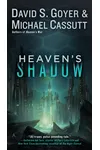
1. Heaven's Shadow (2011)
The story begins in the near future when a massive Near-Earth Object (NEO) measuring roughly 100 miles across, nicknamed "Keanu," is detected on a trajectory toward the Sun. A high-stakes space race ensues between NASA (led by the United States) and a competing coalition of international space agencies (including Russia, India, and Brazil) to intercept the object. Upon landing on Keanu, the competing crews make a startling discovery: it is not an asteroid, but a colossal alien starship containing a desperate message for humanity: "Help us."
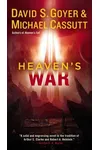
2. Heaven's War (2012)
Picking up immediately after the chaotic events of the first book, the surviving astronauts and groups of humans previously abducted from Earth find themselves stranded inside the interior of Keanu as it begins to accelerate away from the solar system. The survivors must navigate the bizarre, hostile ecosystems within the ship, deal with resurrected human "revenants" who possess a mysterious connection to the ship's enigmatic alien "Architects," and contain a dangerous alien entity whose true intentions remain unknown.
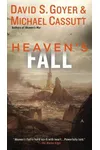
3. Heaven's Fall (2013)
The final book in the trilogy takes a dramatic leap forward, taking place twenty years after the events of Heaven's War. Earth has been occupied and conquered by a hostile, parasitic alien force known as the Reivers, who tracked the Architects' path to our solar system. When contact is finally re-established with the spaceship Keanu, Rachel Stewart—the daughter of the first book's protagonist—leads a desperate human resistance movement. The survivors must uncover the final secrets of Keanu, which represents the last hope for Earth and the wider galaxy.
David S. Goyer's Comic Book Legacy: JSA
Before writing novels, Goyer made a massive impact on the comic book industry. His most significant contribution is his run on DC Comics' JSA (Justice Society of America), which began in 1999. Co-writing initially with James Robinson and later with Geoff Johns, Goyer helped modernize DC's Golden Age heroes for a new generation. The run can be collected and read through two primary methods:
The "JSA by Geoff Johns" Trade Paperback Order
For a streamlined reading order focusing on the core storylines, the standard trade paperback collections are highly recommended:
- Book One: Collects JSA Secret Files #1 and the main series issues JSA #1–15. This volume establishes the new team dynamic and introduces the threat of the Wizard and the Injustice Society.
- Book Two: Collects JSA #16–25, JSA: Our Worlds at War #1, JLA/JSA Secret Files & Origins #1, and the graphic novel crossover event JLA/JSA: Virtue and Vice.
- Book Three: Collects JSA: All Stars #1–8, JSA Annual #1, JSA Secret Files and Origins #2, and JSA #26–31.
The Omnibus Method
If you prefer large, comprehensive hardcover collections, you can read the run via the JSA Omnibus volumes. Goyer co-wrote the series up until issue #40, meaning his direct contributions are contained within JSA Omnibus Vol. 1 and the beginning of JSA Omnibus Vol. 2, after which Geoff Johns took over as the sole writer.
Chronological Continuity vs. Publication Order
When it comes to Goyer's prose, there is no debate: publication order is chronological order. Because the Heaven's Shadow trilogy is a serialized, continuous story, attempting to read the books out of order will spoil major plot points and render the narrative confusing, especially given the twenty-year time jump featured in Heaven's Fall.
For the comic books, chronological reading order matches the trade paperback collections. However, because comic runs involve various tie-ins and special events (such as Virtue and Vice or Secret Files), reading the individual monthly issues in exact chronological order can sometimes be disrupted by crossover events. Stick to the collected editions listed above to ensure a smooth, chronological narrative flow.
What to Know Before You Start
Readers coming to Goyer's books from his films should prepare for a slightly different experience. While his movies like Batman Begins are famous for their dark, grounded realism, his books and comics embrace high-concept science fiction and classic space opera tropes. The Heaven's Shadow trilogy is firmly in the hard science fiction camp, utilizing real-world space technology, orbital mechanics, and detailed physics, before transitioning into cosmic conflicts and alien occupations. Expect fast, screenplay-style pacing with brief chapters that keep the plot moving rapidly.