
Where to Start with Douglas Westerbeke
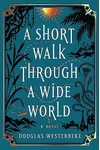
Because Douglas Westerbeke has only one published novel, the starting point is clear: A Short Walk Through a Wide World (2024). This standalone masterpiece serves as the perfect entry point into his style, combining magical realism, historical fantasy, and adventure. Rather than a series of books, the complexity of this work lies within its narrative structure, which spans continents and decades in a non-linear, puzzle-like fashion.
A Short Walk Through a Wide World (2024)
Published in April 2024, Westerbeke's debut novel introduces readers to Aubry Tourvel. Set initially in Paris in 1885, the story follows nine-year-old Aubry after she discovers a mysterious wooden puzzle ball in a forest. Shortly after, she develops a strange, fatal illness. The only cure is constant movement; if she stays in one place for more than a few days, or if she ever returns to a place she has already visited, she will die. This curse launches Aubry on a lifelong, solo journey across the globe, traversing deserts, mountain ranges, and oceans, all while she attempts to uncover the origin of her condition and the purpose of the strange libraries hidden in caves across the world.
Publication Order vs. Reading Pathways
As of 2026, Douglas Westerbeke has published only one novel. Consequently, there is no publication order list to navigate. However, the book itself is structurally unique, prompting readers to contemplate different ways to interpret its timeline:
- The Narrative Order (Recommended): Read the book from front to back. Although Aubry’s travels skip back and forth in time and space, Westerbeke carefully constructs the emotional beats and structural reveals to build to a specific thematic conclusion. Attempting to untangle the timeline chronologically on a first read will dilute the mystery of the underground libraries and the nature of the puzzle ball.
- The Chronological Order (For Re-readers): For a second pass, some readers enjoy mapping Aubry’s journey chronologically from her childhood in Paris (1885) through her decades of movement across places like Russia, China, and the Sahara, up to her later years. This pathway requires keeping track of the historical dates provided at the beginning of various chapters to reconstruct a linear biography of her cursed life.
What to Know Before You Start
Before diving into Westerbeke’s debut, keep these details in mind to align your expectations with his unique storytelling style:
Genre Blend: The novel is frequently compared to The Midnight Library by Matt Haig, The Life of Pi by Yann Martel, and the magical realism of Jorge Luis Borges. It sits at the intersection of historical adventure, magical realism, and philosophical fiction. It is less concerned with explaining the hard mechanics of magic and more focused on the psychological toll of isolation, the beauty of fleeting human connections, and the weight of memory.
Librarian Influence: Westerbeke's background as a long-time librarian at the Cleveland Public Library and his decade of service on the selection panel for the International Dublin Literary Award heavily influence the novel. Books, infinite libraries, and the preservation of human experience are central themes in the narrative.
Screenwriting Roots: Westerbeke studied film at the University of Southern California and York University, writing several practice novels and optioned scripts before his debut. This cinematic background is evident in the episodic, visual nature of Aubry's adventures, which feel like a series of vivid vignettes stitched together by a grand mystery.
Detailed Reading Guide: Exploring the World of Aubry Tourvel
Aubry's journey is vast, and keeping track of her travels can be half the fun. Her travels take her to several notable destinations, each presenting a distinct vignette in the novel:
- Paris, France (1885): The origin of her journey and the place she can never return to. This setting establishes her early life and the onset of the curse.
- The Himalayas & Tibet: Where Aubry encounters remote monasteries and climbs high peaks, testing the physical limits of her curse.
- Underground and Cave-bound Libraries: Mysterious, ancient libraries that exist outside normal geography. These libraries serve as recurring motifs and key locations where Aubry seeks answers about her condition and the nature of human knowledge.
- Global Travels: Across her lifespan, Aubry travels through Russia, China, the Sahara Desert, and various oceans, meeting a cast of transient characters.
Because she can never return to any place she has previously visited, the narrative emphasizes the impermanence of her relationships. Every conversation she has is a final one, giving the book a bittersweet, melancholic tone that sets it apart from traditional high-adventure fantasy.
Practical Reader Advice and Standalone Experience
For readers deciding whether to pick up Westerbeke's book, here is some practical guidance:
- Can it be read as a standalone? Yes. A Short Walk Through a Wide World is a completely self-contained story. The ending provides a resolution to Aubry’s journey, although it leaves some philosophical questions open for the reader's interpretation.
- Is it suitable for book clubs? Highly recommended. The book's selection for Jimmy Fallon’s Tonight Show Book Club and its thematic depth make it excellent fodder for discussions about wanderlust, regret, and what makes a life meaningful.
- Pacing Caveat: Because the narrative is episodic and jumps across time, some readers find the middle section slower as Aubry adapts to her curse. Patience is rewarded as the puzzle pieces of the mysterious ball and the libraries begin to align in the final third of the book.