
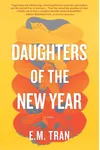
How to Read E.M. Tran: The Recommended Reading Path
As a rising star in contemporary literary fiction, E.M. Tran (Elizabeth M. Tran) has captured readers' attention with her debut novel, Daughters of the New Year, and her award-winning creative nonfiction. Because her work spans multiple generations and weaves between modern Louisiana and ancient Vietnam, navigating her bibliography requires understanding her unique approach to time and structure.
For the best reading experience, we recommend starting with her debut novel before exploring her shorter essays and literary publications. Here is the recommended order:
- Daughters of the New Year (2022) – The core reading experience. We recommend reading this in its published order first to experience the character revelations as the author intended.
- "Miss Saigon" (2016) – Tran's award-winning personal essay (recipient of the Prairie Schooner Summer Nonfiction Prize), which offers a deeply personal look into the themes of identity, media representation, and diaspora that inspired her novel.
- Shorter Fiction and Essays – Companion pieces published in literary magazines like Joyland, The Georgia Review, Harvard Review Online, and the Oxford American, which expand on the cultural tapestry of New Orleans and Vietnamese heritage.
The Structural Puzzle: Reverse Chronology Explained
E.M. Tran's Daughters of the New Year is not a standard linear novel. Instead, the book is written in a reverse-chronological format, peeling back the layers of a family's history like an onion. The novel is structurally split into two primary parts:
- Part 1: 2016–1975 (The Daughters' Present) – This section is set in New Orleans and introduces the Trung sisters (Trac, Nhi, and Trieu) and their mother, Xuan. The timeline moves backward, exploring how events like Hurricane Katrina (2005), the September 11 attacks (2001), and the sisters' childhoods shaped their contemporary struggles and sibling dynamics.
- Part 2: 1975– (The Ancestral Past) – This section delves deeper into the maternal lineage, tracking Xuan's flight from Saigon during the Fall of Saigon in 1975, moving further back to her mother's and grandmother's lives under French colonial rule, and ultimately culminating in the mythic stories of the historical Trung Sisters and Lady Trieu.
Option A: The As-Published Order (Recommended)
Reading the novel in its published order allows you to engage with the text as a mystery. By starting in 2016, you meet the modern Trung sisters as fully formed adults dealing with complex, sometimes strained relationships with each other and their mother, Xuan. As the narrative progresses backward, you begin to understand the "why" behind their actions.
This order is highly recommended because it emphasizes the themes of generational trauma. You witness the effects of trauma before you see its historical causes. When you finally reach the historical and mythological chapters at the end of the book, the legends of the ancient Vietnamese warriors feel like a powerful, haunting echo of the contemporary women you met in the first half.
Option B: The Chronological Reading Order
If you prefer a traditional timeline or are planning a re-read, tracing the story chronologically offers a completely different perspective. Reading from the past to the present highlights the direct passage of habits, beliefs, and expectations down the maternal line. Here is the chronological sequence of the narrative eras:
- Ancient Vietnam (40 CE & 3rd Century CE): The mythic origins of the namesake warriors—the original Trung Sisters (Trac and Nhi) who led a rebellion against Han dynasty rule, and Lady Trieu (Trieu Thi Trinh) who fought Eastern Wu.
- French Indochina Era: The lives of Xuan's grandmother and mother under French colonial occupation, highlighting the early roots of displacement and survival.
- The Fall of Saigon (1975): Xuan's life as a beauty queen in South Vietnam, her marriage, and her dramatic escape from Saigon as a refugee.
- New Orleans Acculturation (Late 1970s–1990s): The birth and childhood of Trac, Nhi, and Trieu in New Orleans, Louisiana.
- The Turn of the Millennium (2001–2005): The impact of national and local crises, including 9/11 and Hurricane Katrina, on the family's stability.
- Modern Day (2016): The culmination of the sisters' individual careers, relationships, and identity crises as they navigate their mother's high expectations.
Meet the Trung Family and Their Zodiac Archetypes
A crucial element of navigating E.M. Tran's work is understanding how the characters relate to the Vietnamese zodiac. The matriarch, Xuan, is obsessed with the zodiac and uses it to interpret her daughters' destinies. The primary characters include:
- Xuan Trung: The mother, a former Saigon beauty queen who guards family secrets closely and uses zodiac signs to dictate her daughters' lives.
- Trac (Year of the Dragon): The oldest sister. As a Dragon, she is expected to carry the family's honor, leading her to pursue a stable but demanding career in law.
- Nhi (Year of the Cat): The middle sister. In the Vietnamese zodiac, the Cat replaces the Rabbit of the Chinese zodiac. Nhi embodies the Cat's independence and grace, pursuing a career in modeling and acting, much to her mother's chagrin.
- Trieu (Year of the Tiger): The youngest sister. Named after the fierce warrior Lady Trieu, she is a competitive weightlifter who struggles to find her place outside of physical competition.
What to Know Before You Start
Before diving into Tran's writing, it helps to understand the dual cultural setting. The stories are deeply rooted in the unique Vietnamese-American community of New Orleans, Louisiana. Tran, who was born and raised in New Orleans, uses the city's distinct geography, French colonial parallels, and experience with Hurricane Katrina to mirror the history of Vietnam.
Additionally, keep in mind that the novel does not follow a singular, continuous plot. It is composed of character-driven vignettes. Each chapter functions almost as a standalone short story, building a larger mosaic of a family's history. Knowing this prevents confusion when the narrative jumps between perspectives and eras.
Expanding the Reading List: Essays and Short Works
To fully appreciate E.M. Tran's voice, readers should look to her creative nonfiction. Her essay "Miss Saigon" is an essential companion piece to Daughters of the New Year. It critiques the musical of the same name and explores how Western media depicts Vietnamese women, providing context for why Tran chose to center strong, complex, and sometimes unlikable Vietnamese-American women in her novel.