










How to Navigate the Emilio Salgari Universe
If you love swashbuckling pirates, untamed jungles, and daring noblemen, Emilio Salgari—often called the "Father of Italian Adventure Fiction"—is a name you need to know. Salgari penned over 200 adventure stories, creating worlds so vivid that generations of readers believed he was a seasoned explorer. In reality, he rarely left his desk in Turin, instead spinning his tales from maps, encyclopedias, and travel journals. For English-speaking readers, approaching his massive catalog can be confusing because the translation history is fragmented, and many books were published in English decades (or even a century) after their original Italian release.
To get the most out of Salgari, you shouldn't just grab a book at random. His works are grouped into distinct, legendary adventure cycles. Here is your practical roadmap to reading Emilio Salgari's most famous sagas.
Your Best Starting Points
- For Jungle & Pirate Action (The Sandokan Cycle): Start with The Tigers of Mompracem. Although The Mystery of the Black Jungle was published slightly earlier, Tigers introduces Sandokan, the charismatic "Tiger of Malaysia," and his loyal sidekick Yanez de Gomera, establishing the heart of Salgari’s most famous series.
- For Classic High-Seas Vengeance (The Black Corsair Cycle): Start with The Black Corsair. This introduces Emilio di Roccanera, the dark and brooding Italian nobleman turned pirate operating in the Caribbean.
The Sandokan / Pirates of Malaysia Reading Order
The Sandokan series is Salgari's masterpiece, detailing the struggles of a Bornean prince who turns to piracy to fight the colonial forces of the British Empire. While Salgari wrote eleven books in this cycle, the core novels translated into English follow a specific order:
- The Tigers of Mompracem (1900): This is the essential introduction to Sandokan, his pirate stronghold of Mompracem, and his obsessive love for Marianna, the "Pearl of Labuan."
- The Mystery of the Black Jungle (1895): Originally written as a separate adventure set in India, this book introduces Tremal-Naik and Kammamuri as they battle the deadly Thuggee cult. Because its characters later merge with Sandokan's crew, it is considered an essential part of the timeline.
- The Pirates of Malaysia (1896): The ultimate crossover. Sandokan and Yanez sail to India to help Tremal-Naik rescue his love, officially merging the two storylines.
- The Two Tigers (1904): Sandokan and his allies return to India to face the Thugs once more in a direct sequel to the events of The Pirates of Malaysia.
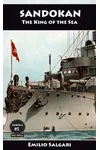
- The King of the Sea (1906): The battle against the British empire escalates as Sandokan acquires modern steamships and battleships, showing a technological shift in the saga.
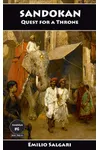
- Quest for a Throne (1907): The pirates help a young prince reclaim his rightful throne in a thrilling adventure filled with palace intrigue and warfare.
Chronological Note: Even though The Mystery of the Black Jungle and The Pirates of Malaysia were published earlier in Italian than the final volume of The Tigers of Mompracem (which Salgari serialized earlier but published as a complete book in 1900), the order above is the standard reading progression recommended by scholars and translators alike to preserve character development and plot continuity.
The Black Corsair Saga (Pirates of the Antilles)
Set in the 17th-century Caribbean, this saga follows the tragic Emilio di Roccanera, the Black Corsair, as he seeks revenge against the Flemish governor Wan Guld, who murdered his brothers. This is a darker, more dramatic series than Sandokan, highlighting Salgari's ability to write complex, morally grey antiheroes.
The correct reading sequence for the Black Corsair saga is:
- The Black Corsair (1898): Emilio di Roccanera begins his quest for vengeance in the Caribbean, allying with historical pirates like Henry Morgan.
- The Queen of the Caribbean (1901): The direct continuation of the Black Corsair’s hunt for Wan Guld, culminating in a dramatic showdown.
- Jolanda, the Black Corsair's Daughter (1905): The focus shifts to the next generation, following Emilio’s daughter Jolanda as she travels to the New World.
- The Son of the Red Corsair (1908): This novel shifts focus to Enrico di Ventimiglia, the son of Emilio’s late brother (the Red Corsair), who searches for his lost stepsister.
- The Last Filibusters (1908): The final book in the Antilles cycle, bringing the adventures of the Ventimiglia family and the era of the classic Caribbean buccaneers to a close.
Translation Gap Caveat: When browsing online databases, you will often see publication years like 2006 for The Son of the Red Corsair and 2020 for The Last Filibusters. Do not be confused! These are the publication years of the modern English translations by publishers like Roh Press. The original Italian novels were both published in 1908, meaning the timeline is continuous and should be read back-to-back.
The Captain Tempesta Duology
One of Salgari’s most progressive works is the Capitan Tempesta cycle. Set during the 1571 Siege of Famagusta, the story follows Duchess Eleonora d'Eboli, who disguises herself as a male knight—the fearsome "Captain Tempesta"—to rescue her imprisoned fiancé from the Ottoman Turks. It is a fantastic mix of military history, romance, and swashbuckling swordplay.
The duology consists of:
- Captain Tempesta (1905): Eleonora’s introduction, her defense of Famagusta, and her developing respect for her honorable rival, Muley-El-Kadel.
- The Lion of Damascus (1910): The sequel that sees Eleonora and Muley-El-Kadel join forces against new threats, leading up to the Battle of Lepanto.
Standalone Novels: The Quest for Buddha’s Scimitar
Salgari also wrote numerous standalone adventure novels set across the globe. A prime example is The Quest for Buddha’s Scimitar. Originally serialized in 1891 and published in book format in 1892 as La scimitarra di Budda, this story follows Giorgio Ligusa, a Genoese sea captain who accepts a bet to retrieve a stolen imperial relic from China. If you see a release date of 2024 for this book, it simply represents its recent translation and publication in English. It serves as a fantastic standalone entry point for readers who want to experience Salgari's fast-paced, descriptive style without committing to a multi-book series.
What to Know Before You Start Reading
Before diving into Emilio Salgari's works, it is helpful to keep a few historical and literary contexts in mind:
- The Imperialism Dichotomy: Writing at the turn of the 20th century, Salgari’s books are remarkably progressive. While many European writers of his era championed colonial expansion, Salgari’s heroes—especially Sandokan—are often native rulers fighting back against British, Dutch, and Spanish colonial oppression.
- The Deskbound Explorer: Salgari wrote about the jungles of Borneo, the temples of India, and the waters of the Caribbean without ever visiting them. His descriptions are incredibly detailed because he spent hours researching in libraries, though modern readers will occasionally spot geographical errors. Treat these as part of the charm of classic pulp adventure!
- Massive Literary Influence: Salgari's work left an indelible mark on global culture. He inspired Spaghetti Western director Sergio Leone, and legendary Latin American writers such as Gabriel García Márquez, Isabel Allende, and Pablo Neruda grew up reading his novels.