



The Recommended Reading Order for World’s End
When diving into Lin Carter’s classic 1970s science fantasy series, also known as the Gondwane Epic, readers face a classic sci-fi dilemma: should you read the books in the order they were published, or follow the chronological journey of the genetically engineered protagonist, Ganelon Silvermane? Because the first book published is actually the final chapter of the story, we strongly recommend reading the series in chronological (narrative) order. Reading chronologically allows you to watch Ganelon’s character grow, understand his origins, and experience the grand climax of the falling moon as it was meant to be resolved.
Here is the recommended chronological reading order for the World’s End series:
- The Warrior of World’s End (1974) – This book functions as the narrative starting point. We meet Ganelon Silvermane, a genetically engineered Construct awakened from a long sleep in a Time Vault, as he begins to navigate the bizarre landscapes of Gondwane, fighting blue giants and finding his footing in a dying world.
- The Enchantress of World’s End (1975) – Ganelon's journey deepens as he encounters the mysterious Scarlet Enchantress, facing magic, illusion, and his own developing sense of humanity.
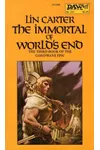
- The Immortal of World’s End (1976) – The cosmic stakes escalate as Ganelon goes head-to-head with godlike entities and ancient powers who pull the strings of the dying planet.
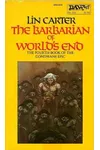
- The Barbarian of World’s End (1977) – In a fan-favorite entry, Ganelon sacrifices his freedom and offers himself as a hostage to the brutal Ximchak Horde. He rises through their ranks, eventually challenges the chief, and attempts to lead these nomadic warriors toward a more civilized existence.
- The Pirate of World’s End (1978) – Leaving the Horde behind, Ganelon sets off on an episodic quest across the oceans of Gondwane to rescue his kidnapped friend Kurdi, dealing with swashbuckling dangers, strange islands, and the princess Dalassa.
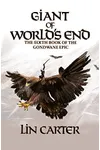
- Giant of World’s End (1969) – The grand finale of the epic. The moon is in a decaying orbit, threatening to crash into Earth and end all life on the supercontinent of Gondwane. Ganelon, alongside the magician Zelobion and a colorful cast of companions, makes his final stand to save the world.
The Publication Order
If you are a purist who wants to experience the series exactly how readers in the late 1960s and 1970s did, you can follow the publication order. Under this path, you start with the apocalyptic finale and then read the subsequent five novels as historical prequels explaining how the world reached that state.
The publication order is as follows:
- Giant of World’s End (originally published in 1969 by Belmont Books; reissued in 1979 by DAW Books)
- The Warrior of World’s End (1974)
- The Enchantress of World’s End (1975)
- The Immortal of World’s End (1976)
- The Barbarian of World’s End (1977)
- The Pirate of World’s End (1978)
What to Know Before You Start
Lin Carter’s Gondwane is a classic example of the 'Dying Earth' subgenre, heavily inspired by Clark Ashton Smith’s Zothique stories and Jack Vance’s Dying Earth series. Set 700 million years in the future, Earth's continents have drifted back together to form the supercontinent of Gondwane. In this era, science has decayed to the point of being indistinguishable from magic, and ancient technology is treated as sorcery.
Carter, who was an influential editor of the Ballantine Adult Fantasy series, packed the World's End books with nods to his favorite pulp writers, including Edgar Rice Burroughs and Robert E. Howard. The tone is fast-paced, episodic, and carries a whimsical, lighthearted humor. Readers will also notice a strong influence from L. Frank Baum's The Wonderful Wizard of Oz—Ganelon's quest to understand his own manufactured nature and find his humanity mirrors the emotional struggles of the Tin Woodman and the Scarecrow.
It is also worth noting that the series was highly regarded by Gary Gygax, who listed Lin Carter as an inspiration in the famous 'Appendix N' of the original Dungeons & Dragons Dungeon Master's Guide. The quirky kingdoms, bizarre cults, and relics of lost civilisations make the series feel like a tabletop campaign brought to life.
Availability and Rarity
Finding copies of the World's End books today can be a bit of a treasure hunt. The books have largely been out of print since their original 1970s runs by Belmont Books and DAW Books. Fantasy collectors frequently search for these vintage paperbacks with their striking, nostalgic cover art in used bookstores and online marketplaces. If you are looking to collect them, keep in mind that Giant of World's End has two common versions: the original 1969 Belmont edition and the 1979 DAW reprint, which was released to complete the uniform paperback set of the prequel series.