
Where to Start with Cal Newport
Cal Newport’s books do not follow a narrative continuity like a fiction series, but his ideas build upon each other in a clear intellectual progression. Reading them in a strategic order will help you absorb his philosophies on career capital, focus, and digital distraction without feeling overwhelmed. Depending on your current life stage and professional goals, there are three primary entry points into his catalog.
The General Professional Path (Recommended)
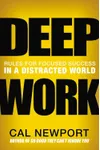
If you are a professional, freelancer, or creator, your best starting point is Deep Work (2016). It is Newport's defining book, laying out the case that intense, distraction-free concentration is a modern superpower. Once you understand the value of depth, work backward to So Good They Can’t Ignore You (2012) to learn how to build the career capital necessary to secure control over your working life. Next, read Digital Minimalism (2019) to clear away the digital clutter that prevents deep focus. Follow this with A World Without Email (2021) to understand how to fix collaborative workflows, and conclude with Slow Productivity (2024) to learn how to sustain this high-value output over a lifetime without burning out.
The Digital Wellness Path
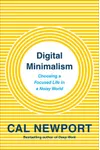
If you feel constantly overwhelmed by notifications, social media, and screen time, start directly with Digital Minimalism (2019). It provides a practical, 30-day digital declutter process. After regaining control of your personal digital life, read Deep Work (2016) to apply these newly reclaimed focus hours to your career or creative projects, and then read Slow Productivity (2024) to establish a sustainable pace of accomplishment.
The Student Path
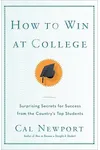
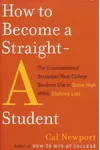
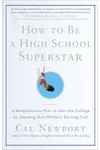
For high school or college students, start chronologically with Newport's early academic guides: How to Win at College (2005), followed by How to Become a Straight-A Student (2006), and finally How to Be a High School Superstar (2010). These guides lay the groundwork for his later theories on focus and efficiency, proving that you can achieve elite academic results without burning out.
Publication Order of Cal Newport's Books
Reading Cal Newport's books in publication order allows you to follow his evolution from a student strategist to an academic researcher, and finally to a leading cultural critic of the digital age. Below is the complete list of his works in chronological order.
1. How to Win at College (2005)
Written while Newport was an undergraduate at Dartmouth, this book contains 75 brief, practical tips for navigating college life. It covers everything from study habits and choosing a major to networking with professors and participating in campus activities. It is a quick, actionable read designed to set a strong baseline for incoming freshmen.
2. How to Become a Straight-A Student (2006)
Rather than offering generic advice, this guide is built on interviews with real high-performing college students. Newport dissects their strategies to reveal how to study less while scoring higher. It introduces foundational productivity concepts, such as time management, conquering procrastination, and writing high-quality papers efficiently.
3. How to Be a High School Superstar (2010)
Targeted at high schoolers looking to get into competitive universities, this book challenges the traditional strategy of overloading on extracurriculars and AP classes. Instead, Newport introduces the "relaxed superstar" concept, advocating for deep focus on a single, compelling interest to stand out organically to admissions officers.
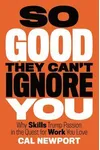
4. So Good They Can't Ignore You: Why Skills Trump Passion in the Quest for Work You Love (2012)
This book represents Newport’s transition into career advice for professionals. He systematically dismantles the common advice to "follow your passion." Instead, he argues that passion is a side-effect of mastery, and that you must first build rare and valuable skills ("career capital") to trade for the traits that define great jobs: autonomy, impact, and creativity.
5. Deep Work: Rules for Focused Success in a Distracted World (2016)
Newport’s breakout bestseller makes the case that our economy is increasingly valuing deep work—cognitive activities performed in a state of distraction-free concentration—at the exact time that technology is making it scarcer. The book is split into two halves: the first half explains the science and philosophy behind the value of depth, while the second half outlines four practical rules for training your cognitive muscles and restructuring your work habits.
6. Digital Minimalism: Choosing a Focused Life in a Noisy World (2019)
Expanding on the ideas of distraction in Deep Work, this book addresses our personal lives. Newport argues that we have let smartphones and social media dictate our attention without our consent. He offers a philosophical framework for technology use, advocating that you should only use digital tools that directly support your deeply held values. It includes his famous "digital declutter" protocol to reset your relationship with screens.
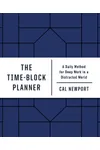
7. The Time-Block Planner (2020)
A physical companion planner designed by Newport to help readers implement the time-blocking methodology described in his books. Rather than running a simple to-do list, this tool encourages readers to divide their day into dedicated blocks of time for specific activities, helping to protect deep work hours and manage shallow administrative tasks.
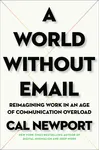
8. A World Without Email: Reimagining Work in an Age of Communication Overload (2021)
While Deep Work focused on individual habits, this book addresses organizational workflows. Newport argues that the "Hyperactive Hive Mind" workflow—relying on constant, unstructured messaging via email and chat channels—is incredibly inefficient and damaging to human psychology. He offers case studies and frameworks for designing structured, asynchronous workflows to replace constant communication.
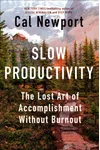
9. Slow Productivity: The Lost Art of Accomplishment Without Burnout (2024)
His latest major work serves as an antidote to modern burnout culture. Newport argues that our current definition of productivity is broken, relying on visible activity rather than meaningful results. He presents a new philosophy built on three main principles: do fewer things, work at a natural pace, and obsess over quality. It offers a historical and practical guide to achieving significant creative and professional feats without sacrificing your well-being.
Thematic Connections and Reading Caveats
When diving into Cal Newport's bibliography, keep in mind that his books fall into distinct thematic duologies and trilogies. The Academic Success Trilogy (his first three books) is highly specialized for students, and general readers can safely skip them. The transition to his professional work begins with So Good They Can't Ignore You.
Furthermore, Deep Work and Digital Minimalism function as a powerful Focus Duology. While the former fixes your professional concentration, the latter repairs your personal relationship with technology. Reading these two back-to-back offers the most immediate life transformation. Finally, A World Without Email and Slow Productivity form a Workflow Evolution Duology, transitioning the focus from individual discipline to structural, long-term changes in how societies and organizations approach labor.