
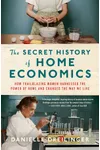
How to Start Reading Danielle Dreilinger's Work
If you are looking to dive into the surprisingly radical history of domestic science, your starting point is clear. Danielle Dreilinger has authored one major non-fiction book that completely redefines how we view a long-neglected discipline. To get the most out of her writing, here is the recommended reading path:
- The Secret History of Home Economics: How Trailblazing Women Harnessed the Power of Home and Changed the Way We Live (2021) – This is her signature work, a narrative history that traces the field from its post-Civil War roots to its modern-day implications.
- Home Work: The Secret History (and Future) of Home Economics (Ongoing Substack) – For readers who finish the book and want to follow the ongoing conversation about modern domestic skills, gender, and social reform, her newsletter acts as the perfect companion piece and digital expansion.
Deep Dive: The Secret History of Home Economics
Far from a dry academic text, Dreilinger's book reads like a narrative saga full of trailblazing chemists, advocates, and educators. The book is structured chronologically and thematically across fifteen chapters, tracing a clear historical arc that helps readers understand the evolution of the field. Knowing this structure helps readers navigate the massive amount of research Dreilinger presents:
Part 1: The Foundations and Early Pioneers (Chapters 1–2)
The book starts with the pre-history of the movement. Chapter 1 ("The Road to Home Economics") and Chapter 2 ("The Lake Placid Conference") detail how the field was born out of a desire to bring scientific rigor to domestic tasks. You will meet Ellen Swallow Richards, the first woman admitted to MIT, who saw home economics not as a way to keep women in the kitchen, but as a gateway to chemistry, biology, and professional independence. These chapters explore the famous Lake Placid conferences where the official discipline was established and named.
Part 2: Wartime Mobilization and the Golden Age (Chapters 3–7)
During the early-to-mid 20th century, home economists became essential to national survival. These chapters show how the field moved from classrooms to the global stage:
- Chapter 3 ("Food Will Win the War") & Chapter 4 ("Perhaps It Wasn't Really a Man's Job After All"): These sections cover World War I, where home economists took charge of federal food conservation efforts, designed diets for soldiers, and proved their administrative and scientific capabilities.
- Chapter 5 ("It's Up to the Women") & Chapter 6 ("Clothes Moths Work for Hitler"): Focusing on the Great Depression and World War II, Dreilinger outlines how home economists helped families stretch pennies, salvage textiles, and manage resources under strict rationing.
- Chapter 7 ("From Coveralls to Housecoats"): This chapter details the post-war transition, where the radical opportunities of wartime began to shift back toward mid-century domestic ideals.
Part 3: Space Age, Social Change, and the Diversity of the Movement (Chapters 8–11)
One of Dreilinger's major achievements in this book is highlighting the voices of Black home economists and the scientific advancements that came from the discipline:
- Chapter 8 ("The Iron Fist in the Oven Mitt") & Chapter 9 ("Selling Mrs. Housewife"): These chapters dive into the Cold War era. Home economists were instrumental in early space research (designing space food and space suits) and consumer advocacy, while also facing corporate pressure to become marketing agents for household appliances.
- Chapter 10 ("New Directions") & Chapter 11 ("New Homemakers Build the Future"): Here, Dreilinger focuses on the critical roles played by Historically Black Colleges and Universities (HBCUs) and leaders like Flemmie Kittrell. It shows how Black women used home economics as a tool for economic uplift, academic achievement, and civil rights organizing.
Part 4: Rebranding, Decline, and the Future (Chapters 12–15)
The final sections of the book tackle the challenges the discipline faced during the second-wave feminist movement and its path forward:
- Chapter 12 ("Beyond Stitching and Stirring") & Chapter 13 ("Addressing the Enemy"): These chapters explore the 1970s and 1980s, when second-wave feminists critiqued home economics as an oppressive institution, leading to a steep decline in enrollment and funding.
- Chapter 14 ("Home Economics at Risk"): Traces the institutional struggles and the rebranding of the field to "Family and Consumer Sciences" in an effort to distance it from outdated stereotypes.
- Chapter 15 ("What Would Ellen Do?") & Conclusion: Dreilinger wraps up the book by looking toward the future, arguing that home economics is more relevant than ever. She advocates for its return to school curricula to teach essential life skills—like financial literacy, cooking, and sustainable living—to all genders.
What to Know Before You Start
Before cracking open Danielle Dreilinger's work, it is helpful to keep a few context clues in mind to shape your reading experience:
- It is Narrative Non-Fiction: While the book is packed with footnotes and meticulous research, the tone remains conversational, witty, and deeply human. It reads more like a group biography of fascinating historical figures than a textbook.
- A Feminist Perspective: Dreilinger explicitly approaches the subject through a feminist lens. She challenges the stereotype that home economics was designed to keep women submissive, showing instead how it was initially a radical movement to get women into scientific labs and university faculties.
- Intersectionality is Key: Unlike older histories of the field that focused primarily on white, middle-class reformers, Dreilinger dedicates significant space to Black and Latina home economists, showcasing how they adapted the discipline to address racial disparities and poverty.
What Is Next for Danielle Dreilinger?
For readers eager to know what the author is working on next, Dreilinger has publicly shared that she is actively researching and writing her second book. While she has kept specific details under wraps, she has noted that the project focuses on women wielding power in unexpected ways throughout history. Until its release, readers can stay updated by subscribing to her Substack, where she routinely publishes essays expanding on home economics, history, and modern domesticity.
Companion Reads for Fans of Dreilinger
If you enjoyed Dreilinger's blend of women's history, domestic science, and cultural analysis, you might want to add these companion titles to your reading queue:
- Something from the Oven: Reinventing Dinner in 1950s America by Laura Shapiro – This book provides an excellent deep dive into the mid-century food industry and how it clashed with traditional home cooking, serving as a perfect thematic bridge to Chapters 8 and 9 of Dreilinger's book.
- The Woman Who Smashed Codes: A Biography of Elizebeth Smith Friedman by Jason Fagone – A narrative biography that, like Dreilinger's work, unearths the hidden history of a brilliant woman who shaped American history in the shadows of a male-dominated field.
- Rise of the Rocket Girls: The Women Who Propelled Us, from Missiles to the Moon to Mars by Nathalia Holt – Excellent for readers who want to learn more about early female scientists and mathematicians who worked in the mid-20th century space age, complementing the sections on space nutrition.
Danielle Dreilinger Books in Publication Order
Here is the chronological order of Danielle Dreilinger's published book-length work:
- The Secret History of Home Economics: How Trailblazing Women Harnessed the Power of Home and Changed the Way We Live (W. W. Norton & Company, May 2021)