






















Where to Start: The Recommended Reading Path
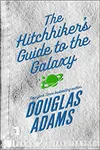
For anyone looking to dive into the comedic genius of Douglas Adams, there is only one logical entry point: the original 1979 novel, The Hitchhiker's Guide to the Galaxy. From there, you should follow the publication order of the main series. Adams' style relies heavily on progressive absurdity, character relationships, and recurring running jokes that build upon previous installments. Starting anywhere else will leave you feeling as confused as a bowl of petunias falling through the sky.
While his famous "trilogy in five parts" is his most celebrated work, Adams also created the quirky Dirk Gently series, co-created Doctor Who stories, and inspired standalone comedic sci-fi novels. To get the complete Douglas Adams experience, read the main Hitchhiker's series first, move on to Dirk Gently, and then explore his posthumous works, adaptations, and non-fiction.
The Hitchhiker's Guide to the Galaxy (The Trilogy in Five Parts)
Originally conceived as a BBC radio series in 1978, Adams adapted the story into a sequence of five novels that became a global phenomenon. These books should be read in strict chronological and publication order:
- The Hitchhiker's Guide to the Galaxy (1979): The book that started it all. We meet Arthur Dent, Ford Prefect, Trillian, Zaphod Beeblebrox, and Marvin the Paranoid Android as Earth is demolished to make way for a hyperspace bypass.
- The Restaurant at the End of the Universe (1980): Continuing directly from the first book, the crew travels to Milliways, the ultimate dining experience situated at the temporal end of existence.
- Life, the Universe and Everything (1982): Arthur and Ford travel through time and space to stop the xenophobic robots of Krikkit from destroying the cosmos. (This book was adapted from an unproduced Doctor Who script concept by Adams).
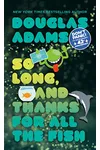
- So Long, and Thanks for All the Fish (1984): Arthur returns to a mysteriously restored Earth, falls in love with Fenchurch, and seeks the Final Message of God to His Creation.
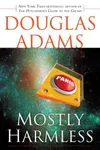
- Mostly Harmless (1992): The darkest and final novel written by Adams, which introduces a multi-dimensional journey and a bittersweet resolution to the guide's saga.
Hitchhiker's Prequels, Spin-Offs, and Extensions
Beyond the core five novels, several companion pieces and continuations exist in the Hitchhiker's universe:
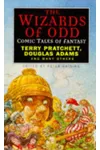
- Young Zaphod Plays It Safe (1986): A prequel short story featuring a younger Zaphod Beeblebrox working as a safety inspector. It can be read at any time, but is best enjoyed after reading book three or four. It is widely available in anthologies such as The Wizards of Odd.
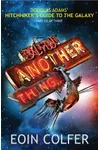
- And Another Thing... (2009): Written by Eoin Colfer (author of the Artemis Fowl series) with the permission of Adams' estate to mark the 30th anniversary of the first book. It provides a more lighthearted and definitive resolution to the cliffhanger ending of Mostly Harmless.
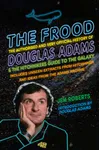
- The Frood (2014): Written by Jem Roberts, this serves as an authorized biography and companion book detailing the history, unused drafts, and cultural impact of the Hitchhiker's phenomenon.
The Dirk Gently Series
After finishing his galactic travels, Douglas Adams turned his attention to detective fiction—but with a heavy dose of quantum mechanics, time travel, and Norse mythology. Dirk Gently is a "holistic" detective who believes in the fundamental interconnectedness of all things. These books should be read in order:
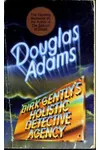
- Dirk Gently's Holistic Detective Agency (1987): Dirk investigates a mysterious murder that somehow involves Coleridge's poetry, quantum physics, and saving humanity from extinction.
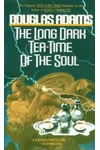
- The Long Dark Tea-Time of the Soul (1988): Dirk deals with Norse gods who have fallen on hard times in modern London, featuring an explosion at Heathrow Airport and a very stubborn vending machine.
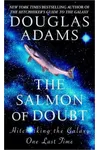
- The Salmon of Doubt (2002): Published posthumously after Adams' sudden passing in 2001. This collection contains articles, essays, letters, and eleven unfinished chapters of what was intended to be the third Dirk Gently novel (which Adams had also considered rewriting as a Hitchhiker's book).
Understanding the Doctor Who Adaptations and the Target Collection
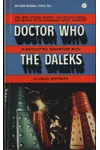
Douglas Adams served as a script editor and writer for the classic era of Doctor Who in the late 1970s. While catalogs and databases often list hundreds of Doctor Who novelizations under his name due to broad publishing categories, Adams did not write these novels himself. Instead, his unproduced or broadcast television scripts were novelized posthumously by other authors:
- Shada (2012): Novelized by Gareth Roberts. This was originally intended to be the final serial of Doctor Who's 17th season in 1979 but was never completed due to BBC studio strikes.
- City of Death (2015): Novelized by James Goss. Based on the highly-rated 1979 serial featuring the Fourth Doctor in Paris, which Adams co-wrote under a pseudonym.
- Doctor Who and the Krikkitmen (2018): Novelized by James Goss. This was a feature film treatment that Adams pitched to the BBC. Though rejected at the time, Adams reused many of its ideas to write his third Hitchhiker's book, Life, the Universe and Everything.
For readers, these novelizations can be read completely independently of Adams' other books, though they share his trademark wit and philosophical sci-fi concepts.
Standalone Works, Co-authored Books, and Non-Fiction
Adams was an early adopter of technology, a dedicated environmentalist, and a lover of language, which led to several notable side projects:
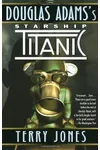
- Starship Titanic (1997): Written by Monty Python member Terry Jones. This comedic novel is based on a CD-ROM adventure game designed by Douglas Adams. While set in a universe that feels adjacent to Hitchhiker's, it is a standalone story about a luxury starship that suffers a "Spontaneous Massive Existence Failure."
- Last Chance to See (1990): A non-fiction book co-authored with zoologist Mark Carwardine. They travel the world to find and document endangered species. Adams often cited this as his favorite and most rewarding project, showcasing his deep empathy alongside his signature humor.
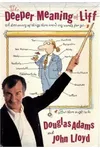
- The Meaning of Liff (1983) and The Deeper Meaning of Liff (1990): Co-authored with John Lloyd, these are humorous dictionaries that attach definitions of common, unnamed human experiences to actual British place names.
What to Know Before You Start: Continuity and Tone
Because Douglas Adams wrote across multiple media—radio, novels, television, and computer games—there is no single "canonical" version of the Hitchhiker's story. The radio series differs from the books, which differ from the TV series and the 2005 film. Adams himself took a relaxed attitude towards continuity, famously stating that the stories contradicted each other because he forgot what he had written in previous versions. Embrace the inconsistencies, pack your towel, and enjoy the comedic journey through the universe!