









Where to Start Reading Anthony Boucher
For readers looking to dive into the work of Anthony Boucher (the pen name of William Anthony Parker White), the best starting point depends on whether you prefer classic Golden Age locked-room puzzles or a blend of mystery and early science fiction. Because Boucher's output was relatively compact but highly influential, his work is easy to navigate. Most readers choose one of two distinct entry points:
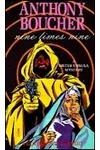
- For Classic Locked-Room Mystery Fans: Start with Nine Times Nine (1940). Originally published under his pseudonym H. H. Holmes, this is widely considered one of the finest locked-room mysteries ever written, introducing the crime-solving nun Sister Ursula.
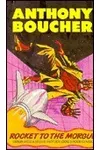
- For Sci-Fi and Pop Culture Enthusiasts: Start with Rocket to the Morgue (1942). Also featuring Sister Ursula, this novel is a roman à clef set within the Southern California science fiction scene of the early 1940s, featuring thinly veiled caricatures of legendary writers like Robert A. Heinlein, L. Ron Hubbard, and Jack Williamson.
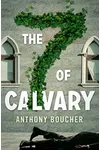
- For the Historical Purist: Start with The Seven of Calvary. Originally published in 1937 as Boucher's debut novel, it introduces the academic sleuth Dr. John Ashwin. Note that while local database listings sometimes record a publishing date of 2019, this refers to a modern reprint; the book itself represents the true beginning of Boucher's publishing career.
The Sister Ursula Mysteries (H. H. Holmes Pseudonym)
Boucher wrote his Sister Ursula novels under the pen name H. H. Holmes—a playful reference to the notorious 19th-century American serial killer Herman Webster Mudgett. Sister Ursula, a nun of the Order of Martha of Bethany, is an amateur sleuth who uses logic, sharp observation, and spiritual insight to assist the police. The series consists of two novels, which should ideally be read in order of publication:
- Nine Times Nine (1940): Introduces Sister Ursula as she investigates a seemingly impossible murder. A cursed author is found dead inside a room that was sealed from the inside, leaving no trace of the killer.
- Rocket to the Morgue (1942): Sister Ursula returns to crack a locked-room stabbing targeting a science fiction writer. The novel is famous for its depiction of early fandom and the Los Angeles sci-fi community.
The Fergus O'Breen Mysteries
Fergus O'Breen is Boucher's signature private investigator: a redheaded, fast-talking, occasionally self-referential Irish detective based in Southern California. The O'Breen novels combine fast-paced detective work with complex, traditional puzzles. While the local database lists three novels, there is an important chronological omission to note: O'Breen's actual debut occurs in a 1939 book not listed in the standard local database.
The complete chronological reading order for Fergus O'Breen is:
- The Case of the Crumpled Knave (1939): The official debut of Fergus O'Breen. He is hired to investigate the death of a research chemist who left behind a series of cryptic, coded messages.
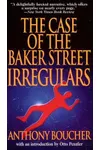
- The Case of the Baker Street Irregulars (1940): A unique entry where Fergus O'Breen is largely absent, and his sister, Maureen O'Breen, takes the lead. The plot involves a group of Sherlock Holmes enthusiasts who hire O'Breen's agency to oversee a movie production, only for a real murder to occur.
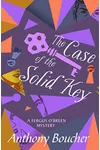
- The Case of the Solid Key (1941): A classic locked-room mystery set in a little theater group, featuring O'Breen using rigorous deduction to explain a murder in an apparently sealed room.
- The Case of the Seven Sneezes (1942): O'Breen is trapped on an island during a silver wedding anniversary celebration that quickly turns into a series of murders.
- The Compleat Werewolf and Other Stories (1969): A posthumous collection of fantasy and science fiction stories. The famous title story, first published in 1942, features Fergus O'Breen in a supporting role, assisting a professor who has discovered he can transform into a werewolf.
The Casebook of Gregory Hood (Radio and Collections)
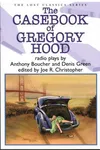
In addition to his novels, Boucher was a prolific radio scriptwriter. Alongside Denis Green, he co-created The Casebook of Gregory Hood in 1946 as a summer replacement for their successful Sherlock Holmes radio drama. Gregory Hood is a wealthy San Francisco importer of rare antiquities who routinely stumbles into bizarre crimes. Though originally broadcast in the 1940s, the scripts and narratives were compiled in the 2009 collection Casebook of Gregory Hood, which is highly recommended for fans of vintage radio thrillers.
Essential Collections and Standalones
To fully experience Boucher's range, readers should explore his standalone works and short story compilations. He was a master of the short format, writing everything from traditional whodunits to science fiction classics:
- The Seven of Calvary (1937): A brilliant, academic mystery set at UC Berkeley, featuring Dr. John Ashwin and Martin Lamb. It stands alone but represents Boucher's first foray into the detective genre.
- Exeunt Murderers (1983): A posthumous collection gathering many of Boucher's best short mystery puzzles, demonstrating his mastery of the locked-room subgenre.
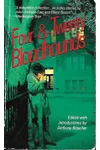
- Four & Twenty Bloodhounds (1985): An anthology edited by Boucher for the Mystery Writers of America, featuring detective stories and Boucher's own editorial commentary.
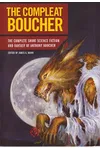
- The Compleat Boucher (1999): The definitive compilation of Boucher's short speculative fiction. It includes his landmark science fiction story The Quest for Saint Aquin (1951), which explores faith, religion, and artificial intelligence in a post-apocalyptic future.
What to Know Before You Start
Boucher's style is characterized by intellectual curiosity, dry wit, and a deep love for games and puzzles. Because he was an active member of both the Mystery Writers of America and early science fiction fandom, his books are filled with inside jokes, references to classical literature, and cameos from his contemporary peers. His novels do not have tight continuity requirements, meaning you can easily read them as standalones. However, reading them in publication order allows you to appreciate his evolving style and his transition from traditional whodunits to genre-bending mystery-sci-fi hybrids.