



Where to Start with Charles Stross
Charles Stross is a master of blending hard science fiction, transhumanism, parallel-world espionage, and workplace satire. Because his bibliography spans several distinct universes and tones, your best starting point depends on what subgenre you prefer:
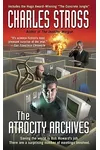
- For bureaucratic humor and Lovecraftian spy thrillers: Start with The Atrocity Archives, the first book in his celebrated Laundry Files series. It is his most popular entry point and perfect for fans of dry British comedy and cosmic horror.
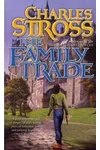
- For parallel worlds, economics, and political intrigue: Start with the streamlined omnibus edition The Bloodline Feud (which combines the first two novels of the Merchant Princes series, The Family Trade and The Hidden Family).
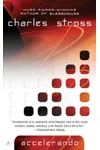
- For mind-bending hard science fiction: Pick up Accelerando, a critically acclaimed standalone novel that explores humanity's transition through a technological singularity.
1. The Laundry Files & The New Management
This is Stross’s longest-running and most famous series. It follows Bob Howard, a programmer who is drafted into a secret government agency ("The Laundry") tasked with defending the UK from Lovecraftian horrors. The magic in this world is actually a branch of applied mathematics, making computers the ultimate occult tools.
As the series progresses, the real-world timeline catches up with the fictional timeline, transitioning from standard espionage to a post-apocalyptic scenario where magic becomes public under an Elder God government ("The New Management").
Main Line & New Management Reading Order
We recommend reading these in publication order, as character arcs, romantic relationships, and global political shifts build directly from book to book:
- The Atrocity Archives (2004) – The novel that introduces Bob Howard and features the Hugo-winning novella "The Concrete Jungle."
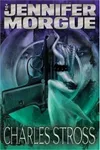
- The Jennifer Morgue (2006) – A satire of James Bond novels involving a deep-sea occult threat.
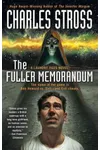
- The Fuller Memorandum (2010) – A darker, Cold War-style thriller dealing with a missing doomsday book.
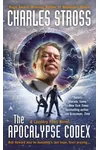
- The Apocalypse Codex (2012) – Bob faces off against an American televangelist who is secretly serving an outer god.
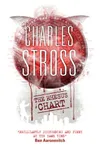
- The Rhesus Chart (2014) – The Laundry is forced to deal with the corporate banking sector being infiltrated by actual vampires.
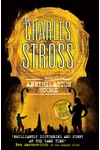
- The Annihilation Score (2015) – Shifting perspective to Mo O'Brien, Bob's wife, as superhero abilities start manifesting in the general public.
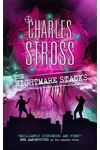
- The Nightmare Stacks (2016) – Follows Alex, a vampire agent, as elvish forces attempt an invasion of Leeds.
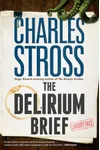
- The Delirium Brief (2017) – The Laundry is publicly exposed and faces privatization and hostile takeovers.
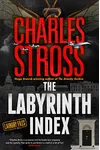
- The Labyrinth Index (2018) – Focuses on Mhari Murphy, as the agency deals with the disappearance of the US government under the influence of Elder Gods.
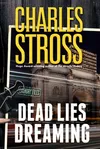
- Dead Lies Dreaming (2020) – Begins the New Management subseries, focusing on a new cast of characters in a post-collapse Britain ruled by an Elder God avatar.
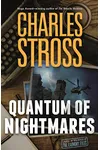
- Quantum of Nightmares (2022) – The second New Management book, diving into corporate horror, gig-economy workers, and supernatural childcare.
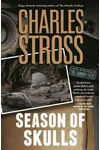
- Season of Skulls (2023) – The third New Management entry, featuring a dark fantasy setting with gothic horror elements.
- The Regicide Report (2026) – The final novel in the mainline Laundry Files sequence, bringing the long-running narrative to a dramatic close as Bob and Mo reunite to protect the British Monarchy from the PM (an Elder God avatar).
Companion Novellas and Collections
Stross has written several short stories and novellas that flesh out the Laundry Files universe. While they can be skipped, they offer fantastic worldbuilding:
- Pimpf (2006) – A short story focusing on Bob supervising interns, usually packaged with The Jennifer Morgue.
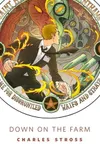
- Down on the Farm (2010) – A novella set between books 2 and 3, following Bob as he investigates a retirement home for former Laundry agents.
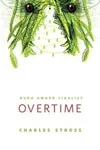
- Overtime (2010) – A Christmas-themed short story about a skeleton crew working during Christmas Eve.
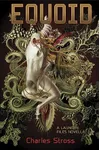
- Equoid (2010) – A Hugo Award-winning horror novella about the terrifying, non-sparkly reality of unicorns.
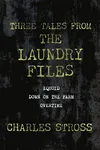
- Three Tales from the Laundry Files (2014) – A collection gathering "Down on the Farm," "Overtime," and "Equoid" into one volume.
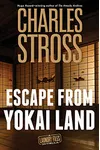
- Escape from Yokai Land (2022) – A novella following Bob Howard on a diplomatic mission to Japan's supernatural defense agency.
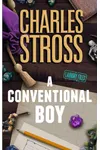
- A Conventional Boy (2025) – A special release comprising a title novella (following Derek, a gamer institutionalized during the 1980s Satanic Panic) along with "Overtime" and "Down on the Farm."
2. The Merchant Princes & Empire Games
This series blends portal fantasy with economic thriller. It follows Miriam Beckstein, a Boston journalist who discovers she belongs to a family capable of walking between parallel Earths—and that they use this power to run a massive, inter-dimensional drug-running cartel.
Original Publication Order vs. The Omnibus Cuts
The original release of the series consisted of six relatively short novels:
- The Family Trade (2004)
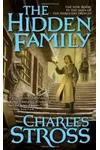
- The Hidden Family (2005)
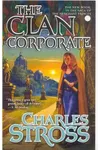
- The Clan Corporate (2006)
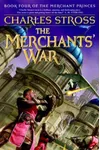
- The Merchants' War (2007)
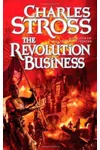
- The Revolution Business (2009)
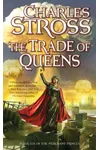
- The Trade of Queens (2010)
Important Reader Advice: Stross later re-edited, streamlined, and combined these six books into three definitive omnibus editions for Tor. This is the author's preferred version, which cuts out repetitive recaps and fixes pacing issues. We strongly advise reading these instead of the original releases:
- The Bloodline Feud (Omnibus 1, combining The Family Trade and The Hidden Family)
- The Traders' War (Omnibus 2, combining The Clan Corporate and The Merchants' War)
- The Revolution Trade (Omnibus 3, combining The Revolution Business and The Trade of Queens)
The Empire Games Trilogy
Set seventeen years after the events of the original sequence, this sequel trilogy shifts focus to a high-tech Cold War between a surveillance-state United States and an industrialized parallel world.
- Empire Games (2017)
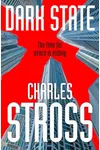
- Dark State (2018)
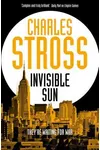
- Invisible Sun (2021)
3. The Eschaton Duology
This is Stross’s take on space opera. It centers around a godlike AI called the Eschaton, which has relocated most of Earth's population across the galaxy and strictly bans any faster-than-light actions that could violate causality and create time-travel paradoxes.
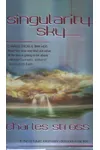
- Singularity Sky (2003)
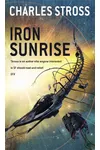
- Iron Sunrise (2004)
These two books are also available in a combined omnibus titled Timelike Diplomacy. While fans have long requested a third installment, Stross has indicated that the series is complete as a duology.
4. The Freyaverse (Saturn's Children)
These novels are set in a post-human solar system where biological humanity has gone extinct, leaving behind their gynoids, androids, and machine servants to maintain a bizarre replica of human society.
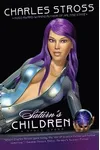
- Saturn's Children (2008) – A tribute to Robert A. Heinlein's late-period novels, following a female android designed as a courtesan finding a new purpose.
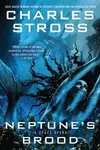
- Neptune's Brood (2013) – Set thousands of years later, this novel follows a clone specialist as she navigates interstellar colonization, space piracy, and the complex economics of space travel. It works perfectly well as a standalone story.
5. The Halting State Series
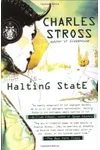
A near-future techno-thriller series focusing on virtual economics, cyberwarfare, and police work in a newly independent Scotland. Although planned as a trilogy, the final book (working title Lambent Amber) was abandoned because real-world political developments and leaks (such as the Snowden revelations) made the fictional premise obsolete.
- Halting State (2007)
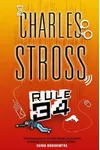
- Rule 34 (2011)
6. Notable Standalone Novels & Collaborative Works
If you prefer self-contained stories, Stross has written some of the most influential standalone hard sci-fi of the 2000s:
- Accelerando (2005) – A timeline of three generations of a family living before, during, and after a technological singularity.
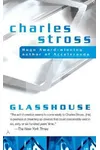
- Glasshouse (2006) – Set in a post-singularity society, this psychological thriller follows a veteran who enters a simulation of a 20th-century suburban town to escape trauma, only to find it is a trap.
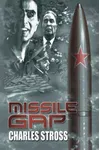
- Missile Gap (2006) – A dark alternate-history novella where Earth's continents are transplanted onto a massive, flat planet.
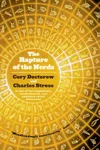
- The Rapture of the Nerds (2012) – A satirical, chaotic take on post-humanism co-authored with fellow sci-fi writer Cory Doctorow.
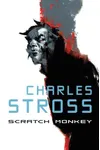
- Scratch Monkey (2011) – A darker, early novel written by Stross in the 1990s but officially published later, exploring uploaded minds and interstellar colonizers.
7. The Warhammer 40k Catalog Confusions
A common error on book cataloging sites is the attribution of a massive list of Warhammer 40,000 novels to Charles Stross (often due to shared database tags). Stross has not written any Warhammer novels. His only contribution to the universe is a single short story, "Monastery of Death," published in the classic 1990 anthology Deathwing (edited by Neil Jones and David Pringle). Readers searching for his bibliography should disregard any other Warhammer 40k listings.